


AI Content Creation
AI Writing Tool Pricing: Seats, Credits, Documents, and Article Caps
AI writing tool pricing compared by model: seats, credits, document caps, and article limits. Includes dated vendor examples and a cost-per-article worksheet.
Build an AI writing workflow with approved facts, specific briefs, brand voice examples and a practical editorial review checklist.
AI-assisted writing becomes more useful when the inputs explain who the page serves, what it must answer and which facts it may use. A topic alone leaves too many decisions unspecified. A working brief should include the audience, intent, outline, approved product facts, sources, voice examples and the action the reader can take next.
SaaS operators need accurate descriptions of features and integrations. Small businesses need clear service information without invented locations or promises. Agencies need a repeatable brief format that still preserves each client's identity. Automation can assist with the process; it does not make an unsupported statement true.
Begin with a question the reader is trying to resolve. Collect evidence before drafting claims about prices, capabilities, results or comparisons. Separate approved facts from editorial suggestions so the writer can tell which details are safe to assert.
Draft the explanation in the reader's order: answer, practical steps, example, limitations and next action. Then review the draft for accuracy, completeness and readability. Check links and source dates as well as the sentences themselves. An editor should be able to identify why each specific claim belongs on the page.
Vague instruction: Write about automating content for agencies.
Illustrative improved brief: Explain how a small agency can move an approved article brief into drafting and client review. The audience manages several client brands. Show a handoff checklist, separate brand-specific facts from reusable process steps, and explain what happens when a required source is missing. Do not claim that a particular product publishes without approval unless that behavior has been verified.
Draft opening: Before automating article production, define what makes a brief ready. Each client needs an approved audience, a source of product facts, voice examples and a reviewer. Missing inputs should stop the handoff rather than become guesses in the draft.
The improved brief gives the writer an audience, a concrete process and a boundary. Its opening answers the operational question instead of introducing automation in general terms.
Use approved voice examples to guide vocabulary and tone. Avoid copying their claims or structure into unrelated content. For agencies, store examples with the correct client so an automation cannot borrow another brand's promises.
Provide the reader and intent, approved facts and sources, the questions to answer, an outline, voice examples and the desired next action. Include explicit exclusions where a claim or feature must not be invented.
Verify claims about capabilities, prices, performance, regulations and named organizations. Review any statement whose accuracy could change the reader's decision. Keep illustrative examples clearly labeled and avoid presenting them as measured outcomes.
Explore RoboWrite features to compare the product with the workflow your team needs. Bring one real brief, your approved brand facts and your CMS requirements to the evaluation.
AI writing tool pricing compared by model: seats, credits, document caps, and article limits. Includes dated vendor examples and a cost-per-article worksheet.
Set up a ChatGPT or Claude project for blog writing in six steps: instructions, reference files, a brief template, and a review routine. See where it stops.
ChatGPT and Claude can write a good draft. See where direct chat costs a content team time: context, planning state, evidence, review, and publishing handoff.
Copy an SEO content brief template with a worked SaaS example. Set reader intent, coverage, sources, exclusions, article elements, and review criteria.
Before you write SEO content, extract brand voice from client URL pages that show how the business speaks to real customers. Sample several page types, capture recurring language patterns, and turn those patterns into testable rules. This approach prevents generic copy and gives your team a…
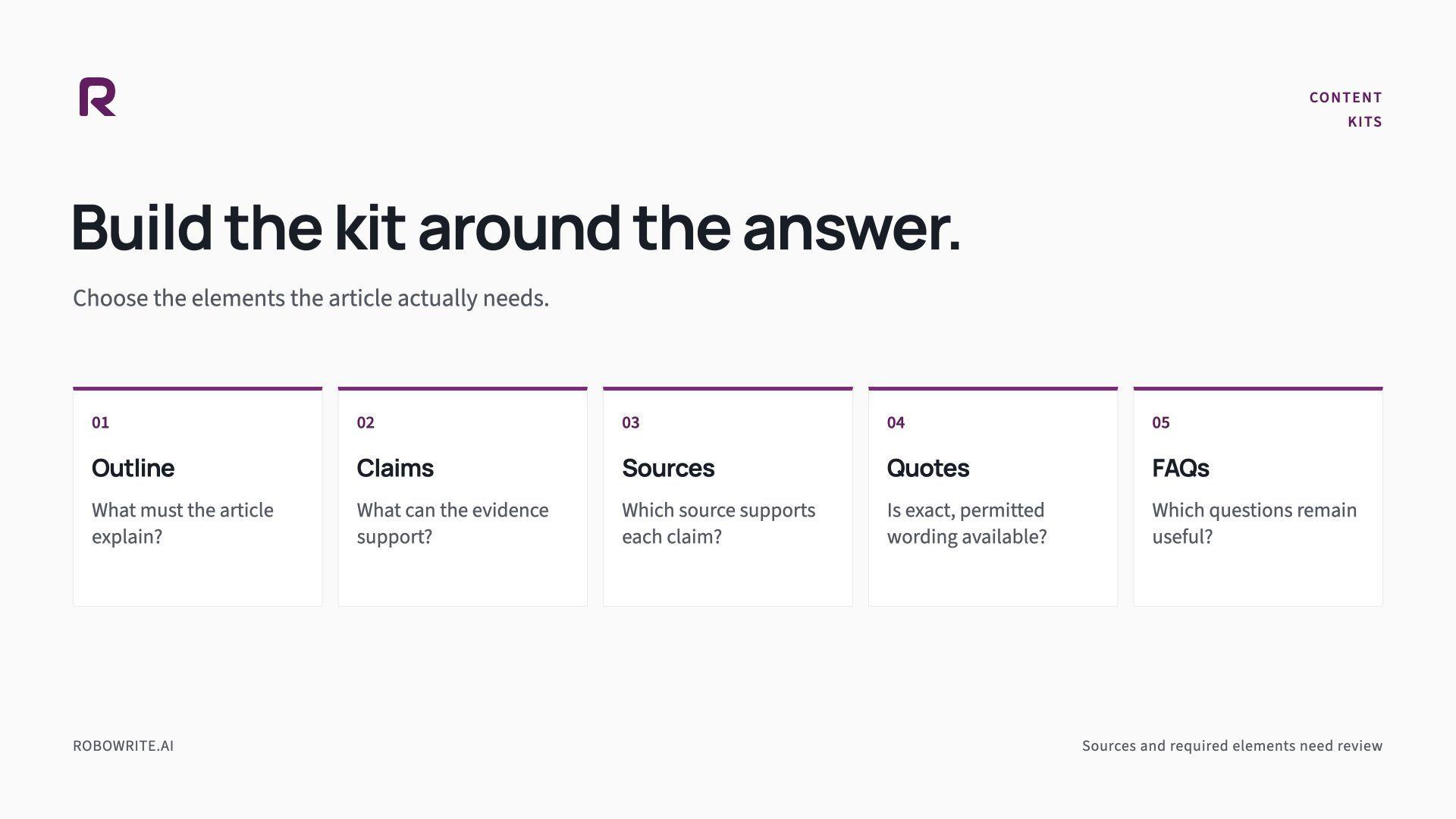
Turn a written SEO brief into Content Kit requirements. Separate coverage, facts, sources, quotes, FAQs, and review decisions before drafting.
Choose useful quotes, sources, and FAQs for a Content Kit. Work through evidence, attribution, required elements, and missing-source review decisions.

A short blog post works best when it answers one clear question. Five hundred words is a useful editing constraint for a focused topic; it is not a search-ranking requirement. If the reader needs a detailed comparison or a complex procedure, choose a longer format.

A portfolio page should help a prospective client recognize a problem you can solve. Screenshots alone rarely explain the assignment, your role or the result. Build each project page around the decision a buyer needs to make: is this team a credible fit for my work?