

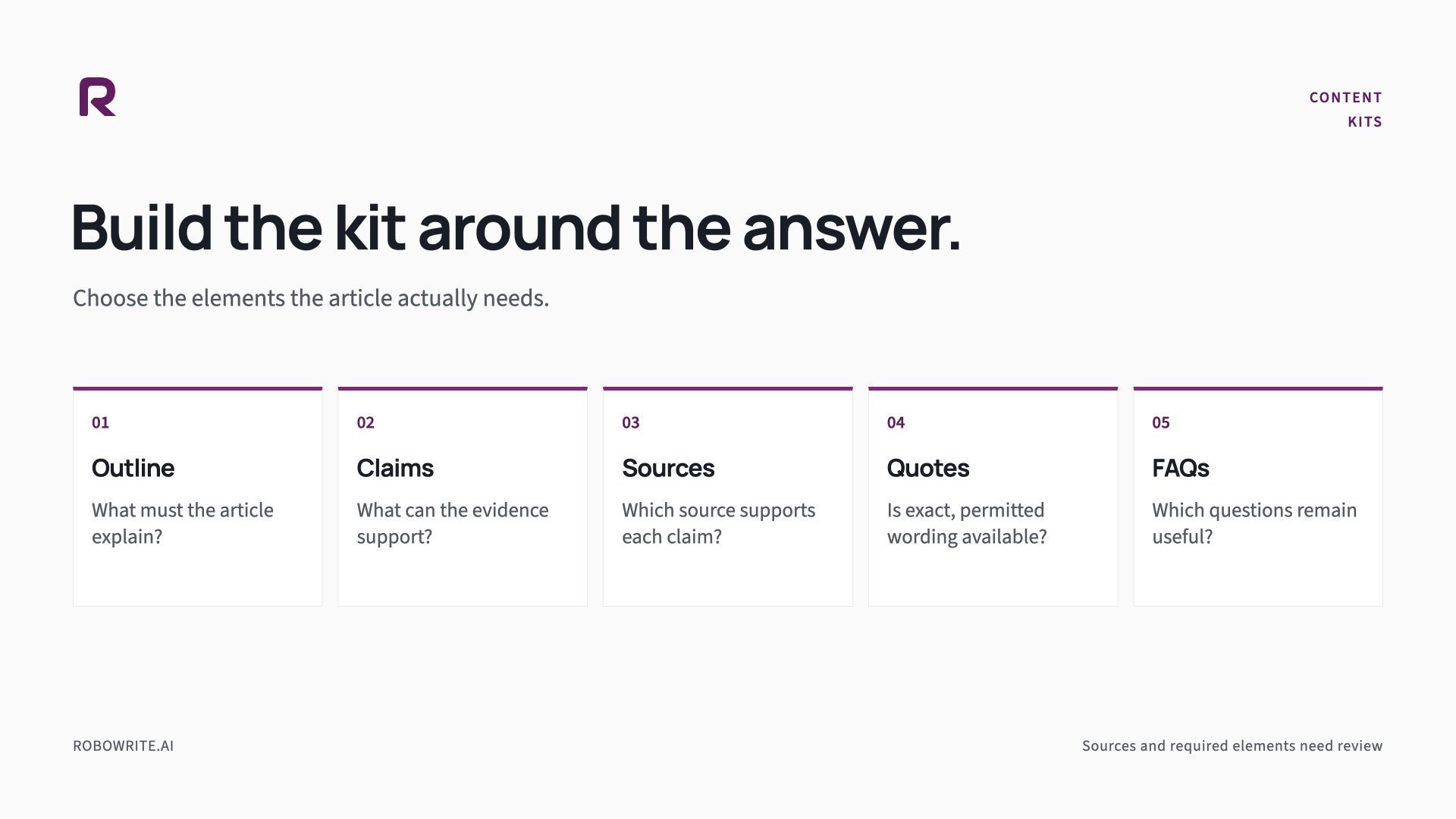
Build a Content Kit by deciding which elements help the reader, supplying the supporting material, and reviewing what the evidence can actually support. Quotes, sources, statistics, tables, and FAQs are useful when they improve the answer. They should not become a checklist of decorations every article must contain.
In RoboWrite, the kit holds the outline, supporting claims, and components used to prepare an article. Brief controls let you express requirements and preferences, while kit review can reveal that a required element lacks usable evidence.
Begin With the Reader's Task
For this worked example, the article will help a SaaS founder prepare an AI-assisted marketing draft for editorial review. It needs a practical review process, an explanation of source support, and answers to a few common questions.
This is an illustrative editorial assignment, not a recorded generation run. The source quotation below is real and attributed; the example does not imply that a product workflow has been tested or that a brand's source policy will admit the same page automatically.
Choose Elements Before Asking for Prose
| Element | Decision for this example | Why it helps |
|---|---|---|
| Outline | Explain preparation, evidence, drafting, and review | Keeps the article focused on the workflow |
| Sources and citations | Include sources for specific external guidance | Lets the reviewer inspect the basis of a claim |
| Quote | Use one relevant, attributed excerpt if eligible | Separates the source's wording from the writer's paraphrase |
| FAQ | Answer source and review questions the article leaves open | Adds useful clarification without repeating the main guide |
| Statistics | Omit | No relevant measured dataset is supplied |
| Comparison table | Omit | The article is not comparing products or options |
| Key takeaways | Include if they summarize the final answer accurately | Helps a reader remember the decisions |
In the product, modes vary by element. Citations support Required or Optional; the steps component is currently off; comparison tables support Optional or Off. Use the controls actually offered by the brief editor. A manually written process explanation is different from enabling an unsupported structured component.
Give a Quote Exact Wording and Attribution
Google Search Central's guidance on generative-AI content states:
It is critical to manually factcheck and review all AI-generated content for accuracy and trustworthiness before publishing.
Attribute that excerpt to Google Search Central's guidance on generative-AI content. It is guidance from a named organization, not a customer testimonial or an interview with an expert.
For a quote record, keep the wording, attribution, source URL, and reason it belongs in the article. If you use a private interview or customer statement, confirm publication permission and any approved context. Never turn a suggested paraphrase into a quotation or invent an expert to satisfy a quote requirement.
The example source supports a statement about editorial review of AI-generated content. It does not substantiate a claim that a particular writing product is accurate, that one workflow increases traffic, or that every search engine uses the same rules.
Attach Sources to Claims, Not Just to the Article
A source list becomes useful when the reviewer can connect a claim to the relevant page. If a sentence describes a product capability, check the actual product documentation. If it summarizes a policy, read the policy in context.
In RoboWrite, sources are derived from supporting claims. The API does not allow arbitrary raw Markdown or an independently edited sources component to bypass that relationship. Supplied facts and their source URLs have their own validation rules.
Keep two questions separate: is the source eligible under the brand's policy, and does its content support this particular statement? A reputable domain alone does not answer the second question. A page that cannot be fetched or does not contain the relevant information should not be represented as verified evidence.
Choose FAQ Questions That Add Information
For this assignment, a useful FAQ might ask:
- What should I do when a required source is unavailable?
- Can I use a supplied product fact without treating it as an external quote?
- Does choosing a FAQ guarantee visibility in AI answers?
Write the answers from the actual evidence and product contract. Missing evidence can require a brief change, a different source, or an explicit review decision. A supplied fact should retain its origin and attribution. A FAQ can help readers, but no FAQ format guarantees that a search engine or AI system will include the page.
Avoid adding questions solely to repeat target phrases. If the article already answers a question clearly, link to that explanation or improve it rather than reproducing the same paragraph at the bottom.
Review Gaps Before Approving the Kit
A required quotation without eligible attributed material is a gap. So is a required source with no supporting claim. RoboWrite's kit review findings can expose these conditions.
Read the finding and make a deliberate choice: add suitable evidence, change the requirement, or hold the work. Approval or waiver does not manufacture support for a factual statement. Check the resulting draft again, because the kit and the final prose are different review surfaces.
The dashboard exposes brief controls and held-kit findings; API and enabled agent surfaces can expose additional component actions. Do not assume every action appears in a visual kit editor.
Next Step
Choose one article and write down which elements it genuinely needs. Explore RoboWrite Content Kits, then use the brief-to-kit workflow to review the supporting material before drafting.
Sources and Further Reading
- Google Search Central: generative-AI content guidance: source of the attributed quotation.
- Google's AI-features guidance: public guidance on inclusion in Google's AI search experiences.
- RoboWrite Public API guide: kit components, supplied facts, source validation, and review findings.