
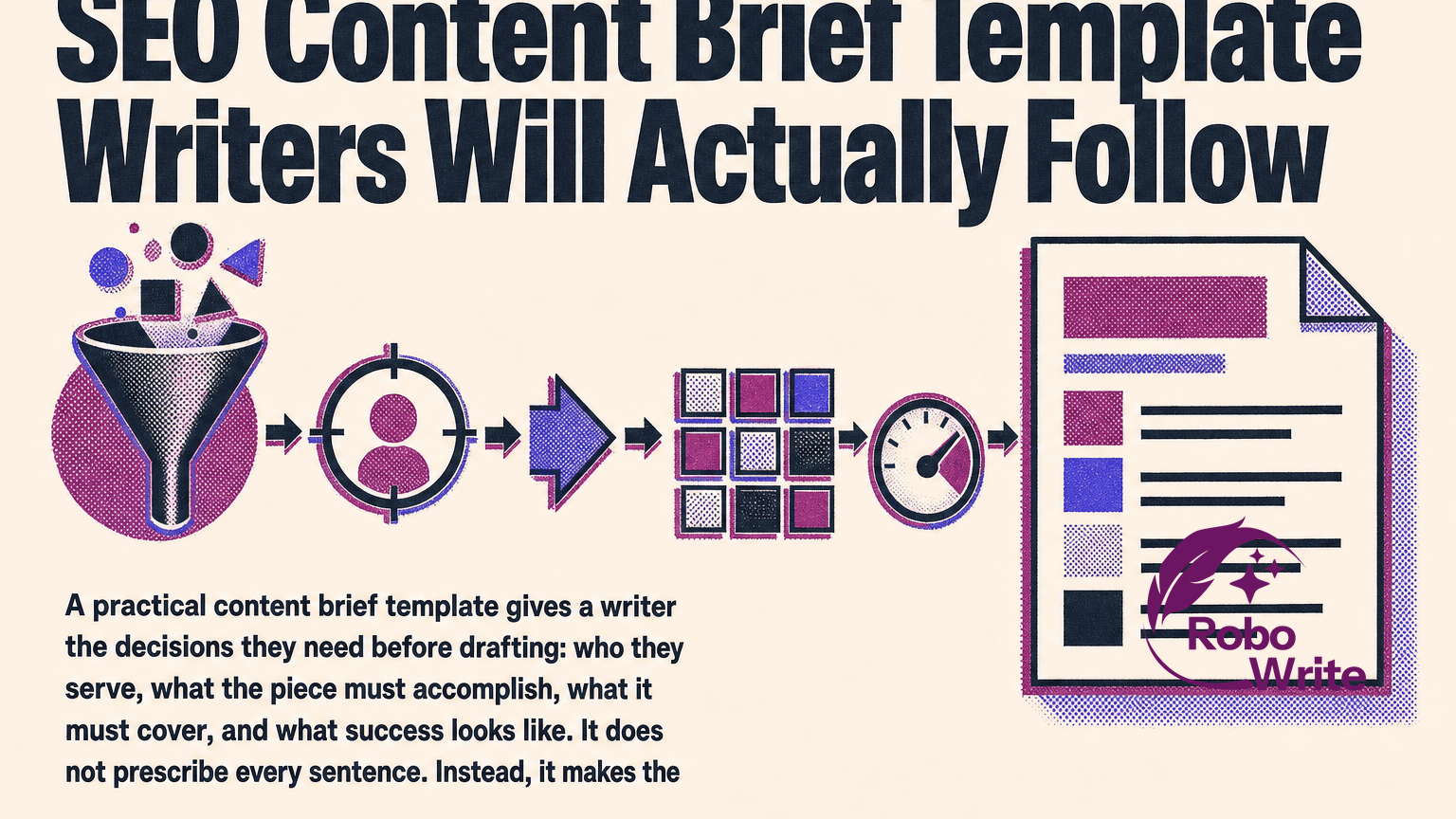
A practical content brief template gives a writer the decisions they need before drafting: who they serve, what the piece must accomplish, what it must cover, and what success looks like. It does not prescribe every sentence. Instead, it makes the non-negotiables clear and leaves room for the writer’s expertise.
For small business owners and freelance marketers, that clarity matters. A structured brief helps align stakeholders and reduce avoidable rewrites by putting the project’s purpose, audience, messaging, deliverable, and sources in one place before writing starts. Use the framework below for blog posts, website pages, emails, and social campaigns.
Why Most Content Briefs Fail Writers
Most briefs fail because they describe a topic, not an assignment. “Write about local SEO” leaves a writer to guess the audience, business goal, search intent, scope, tone, and desired action. The result may read well yet miss the reason you commissioned it.
A useful SEO brief aligns people early around expectations before the work begins. It tells the writer which decisions are fixed and which ones they can improve. For example, the primary keyword, target reader, objective, factual claims, and required links may be fixed. A suggested title or subheading can remain flexible if the writer finds a stronger option.
Keep the brief concise, but do not assume context. Give a freelancer the same practical information you would give an in-house teammate. Clear direction helps content move through production faster with fewer open questions, while vague instructions create review cycles that a better brief could have prevented.
What to Include in an SEO Content Brief Template
Build your content brief template around the order a writer uses information: context, search direction, structure, evidence, and production rules. Include these fields.
Project overview and objective. State the deliverable and business purpose in two or three sentences. Name the format, such as a 1,200-word blog post or a 700-word service page. Then define the reader outcome: what should the reader understand, decide, or do after reading?
Useful entry: “Create a beginner-friendly blog post that helps independent retailers choose three local SEO priorities for the next month.”
Audience, message, and deliverable. Describe the reader’s role, knowledge level, problem, and constraints. Add one central message the article should reinforce. Specify the deliverable, deadline, and required assets. Effective briefs bring together the project overview, purpose, audience, messaging, deliverables, and source materials in a shared direction.
Useful entry: “Audience: owners of one- to five-location retail businesses who know basic marketing but lack time. Message: start with practical actions, not advanced technical work.”
Search and SEO direction. Name one primary keyword, the search intent, and a small set of supporting topics. Give a suggested title, URL slug if needed, target length, and the search-result format you want to address, such as a comparison, checklist, or step-by-step guide. SEO briefs commonly include search intent, keywords, competitive context, and desired length to guide the draft.
Do not paste a long keyword list without priorities. Mark the primary keyword as required. Label secondary phrases as optional when they fit naturally.
Structure and scope. Provide an H2-level outline, key questions, and boundaries. Tell the writer what to include and what to leave out. Outline guidance works best when it covers the headings and the key point each section must deliver, not every sentence the writer should use in the finished article.
Useful entry: “Cover profile optimization, reviews, and location pages. Do not cover paid search, ecommerce SEO, or agency selection.”
Sources, links, style, and review. Add credible source URLs, subject-matter-expert notes, required internal links, and any appropriate reader next step. Define tone with plain descriptors and a short example. Finally, list the approval criteria: accuracy, required coverage, link placement, formatting, and any editing process. This protects the writer from hidden standards and makes review more predictable.
How to Fill Out the Template Step by Step
Start with the business goal, not the keyword. Ask what the content needs to achieve and what useful outcome the reader should get. “Increase awareness” is too broad. “Help first-time buyers compare two service options so they can request the right consultation” gives the writer a usable destination.
Next, identify the reader and their situation. Name what they already know, what is blocking them, and what language they use. A marketer writing for busy restaurant owners needs a different level of detail than a writer addressing experienced ecommerce managers.
Then translate search intent into an angle. Search the primary phrase and observe whether the results teach, compare, list options, or direct users to a specific resource. Choose a scope that answers that need without copying competitors. Search intent should shape the content’s purpose and format, while competitor pages serve as research rather than a blueprint.
Build a working outline from the questions the reader needs answered. For each H2, add one sentence explaining its job. Include only the subtopics needed to fulfill the promise. A clear heading structure gives writers a route through the piece and keeps stakeholders aligned on required coverage from the outset.
Set SEO rules that support readability. Require the primary phrase in high-value locations when appropriate, then let the writer use related language naturally. Specify title, meta description, heading, URL, and formatting requirements only when they matter. If you see a relevant snippet format, such as a list, note it so the writer can organize the answer clearly for that result type.
Supply evidence before the assignment starts. Link to reputable sources, customer research, approved statistics, product details, or expert comments. State which claims require citations and which sources the writer must use. Provide internal links with anchor-text guidance and explain the reader benefit of each link.
Finish with acceptance criteria. For example: “Answer the three listed questions, use the supplied sources for factual claims, include two internal links, stay within 1,100–1,300 words, and flag any unsupported claim before drafting.” Invite the writer to identify gaps. They may find that a source is weak, the scope clashes with intent, or an expert insight would improve the piece.
A Filled-In Content Brief Template Example
Here is a concise Content brief example for a small business blog. Items marked Required are fixed. Items marked Flexible invite the writer’s judgment.
Project: Blog post: “Local SEO Checklist for Independent Retailers”
Objective — Required: Help store owners choose three practical local SEO tasks they can complete this month.
Audience — Required: Owners of independent retail shops with one to five locations. They understand basic online marketing but have limited time.
Primary keyword — Required: local SEO checklist
Search intent — Required: Informational. Readers want a practical, ordered checklist.
Angle — Required: Focus on actions a small team can control without advanced technical expertise.
Suggested title — Flexible: “A Local SEO Checklist for Independent Retailers”
Length and format — Required: 1,200–1,400 words. Use short paragraphs, an introductory checklist, H2 sections, and a closing summary.
Outline — Required:
- Explain what local SEO helps a retailer improve.
- Cover Google Business Profile accuracy.
- Cover customer reviews and response practices.
- Cover location-page basics.
- End with a one-month action list.
Scope boundaries — Required: Exclude paid ads, ecommerce product optimization, and technical site audits.
Sources — Required: Use the supplied business documentation and approved research links. Cite factual claims. Ask before introducing performance statistics.
Voice — Required: Clear, encouraging, and practical. Explain unfamiliar terms in plain language.
Links — Required: Add links to the retailer’s store-locator page and contact page where they genuinely help the reader.
Writer latitude — Flexible: Improve the title, add a relevant question subheading, or suggest a missing source. A strong creative brief stays concise while providing the audience, brand information, and assets the creator needs to do useful work.
Make Briefs Easy for Writers to Use
Organize the brief in the sequence a writer works: context first, SEO direction second, structure third, then sources and production requirements. Use labels, bullets, and direct URLs instead of dense notes. A writer should find the primary keyword, target reader, required sections, and source rules in under a minute.
Avoid conflicting instructions. Do not ask for a “quick beginner guide” and a comprehensive expert resource in the same assignment. Avoid unexplained jargon, repeated keywords, and rigid outlines that prevent a writer from improving clarity. Briefs should guide writers and stakeholders toward aligned expectations rather than replace judgment.
Use three priority labels: Required, Preferred, and Flexible. This small distinction prevents a writer from mistaking brainstorming notes for approval criteria. Encourage questions when the topic, source quality, or intent changes the best approach.
When the brief is complete, it can also serve as clear input for whichever drafting process you use. If RoboWrite is part of your workflow, use the same approved objective, audience, outline, evidence, tone, and acceptance criteria to keep the handoff consistent. Review any draft against the brief’s requirements for coverage, factual support, search intent, links, tone, and scope.
Copy-and-Paste SEO Content Brief Template
This is a copy-ready resource, not a downloadable file: paste this content brief template free into a document, spreadsheet, or project tool. It works as a content brief template Google Docs layout, a content brief template Word file, or a starting point for a website content brief template.
PROJECT TITLE:
CONTENT FORMAT AND LENGTH:
PUBLISHING DATE / DEADLINE:

BUSINESS OBJECTIVE:
READER OUTCOME:

TARGET AUDIENCE:
- Role or situation:
- Knowledge level:
- Main problem:

CORE MESSAGE:

PRIMARY KEYWORD: [Required]
SEARCH INTENT: [Informational / Commercial / Transactional / Navigational]
SUPPORTING TOPICS OR KEYWORDS: [Preferred]
SUGGESTED TITLE: [Flexible]
URL SLUG:
META DESCRIPTION REQUIREMENTS:

ANGLE:
SCOPE: Include:
SCOPE: Exclude:

REQUIRED OUTLINE:
1.
2.
3.

QUESTIONS THE CONTENT MUST ANSWER:
-
-
-

APPROVED SOURCES / EXPERT INPUT:
-

INTERNAL LINKS AND ANCHOR GUIDANCE:
-

EXTERNAL LINKS, IF NEEDED:
-

TONE AND STYLE:
FORMATTING REQUIREMENTS:
READER NEXT STEP, IF APPLICABLE:

ACCEPTANCE CRITERIA:
-
-
-

WRITER NOTES: Flag missing evidence, intent conflicts, or scope concerns before drafting.
Adapt the fields to the format. A social post may need a hook, platform, character limit, and asset notes. A service page may need proof points, objections, conversion path, and page sections. A blog post may need a fuller outline and research list. You can also use a content brief generator for a first-pass structure, then add the business context and evidence that make the assignment specific.
A strong content brief template does not make writing mechanical. It removes avoidable guessing so you and your writer can focus on the useful decisions: the reader, the purpose, the evidence, and the clearest way to deliver the answer.
Sources
- Writing an Effective Content Brief — https
://wgcontent.com/blog/how-to-write-an-effective-content-brief - What Is A Content Brief, And Why Is It Important? [Template] — https
://contentharmony.com/blog/what-is-a-content-brief - What is a content brief (with examples)? | The Jasper Blog — https
://jasper.ai/blog/content-brief - SEO Content Brief Guide: Everything You Need to Know — https
://semrush.com/blog/seo-content-brief - How to Write an SEO-focused Content Brief for Your Writers — https
://minuttia.com/content-brief - How to Write SEO-Focused Content Briefs in 8 Easy Steps — https
://contentharmony.com/blog/how-to-build-content-briefs - How to Create the Perfect SEO Content Brief [Template] — https
://beomniscient.com/blog/seo-content-brief - How to Write a Great Creative Brief — https
://contentmarketinginstitute.com/content-optimization/how-to-write-a-great-creative-brief