

Keyword clustering groups related search terms so you can decide which questions belong on the same page and which need separate answers. The useful output is a page decision: its audience, main question, supporting coverage, and relationship to existing content.
This example shows an editorial review process for a SaaS topic. The keyword list is illustrative, with no search-volume, difficulty, ranking, or traffic measurements. It is not presented as output from a RoboWrite run.
Start With a Reader and a Bounded Keyword List
Assume the intended reader is a small SaaS team's operations lead preparing customer onboarding. The business wants to explain its expertise without turning every question into a product pitch.
The seed topic is customer onboarding. The candidate list contains several kinds of task:
| Candidate keyword | What the reader may need |
|---|---|
| SaaS customer onboarding checklist | A preparation checklist |
| customer onboarding requirements | Information to gather |
| customer onboarding handoff checklist | Responsibilities at a handoff |
| customer onboarding meeting agenda | A plan for a meeting |
| onboarding software comparison | Criteria for choosing software |
| customer onboarding tools for small teams | Tool evaluation with a team-size constraint |
| onboarding tool implementation questions | Questions to ask before committing |
| onboarding completion definition | An operational definition |
| customer onboarding success metrics | A measurement framework |
| track onboarding milestones | A way to record progress |
At this stage, a phrase is a hypothesis about intent. Inspect real search results and audience evidence before treating it as a confirmed assignment. A term can have meanings your initial list does not capture.
Separate the Reader's Tasks Before Naming Clusters
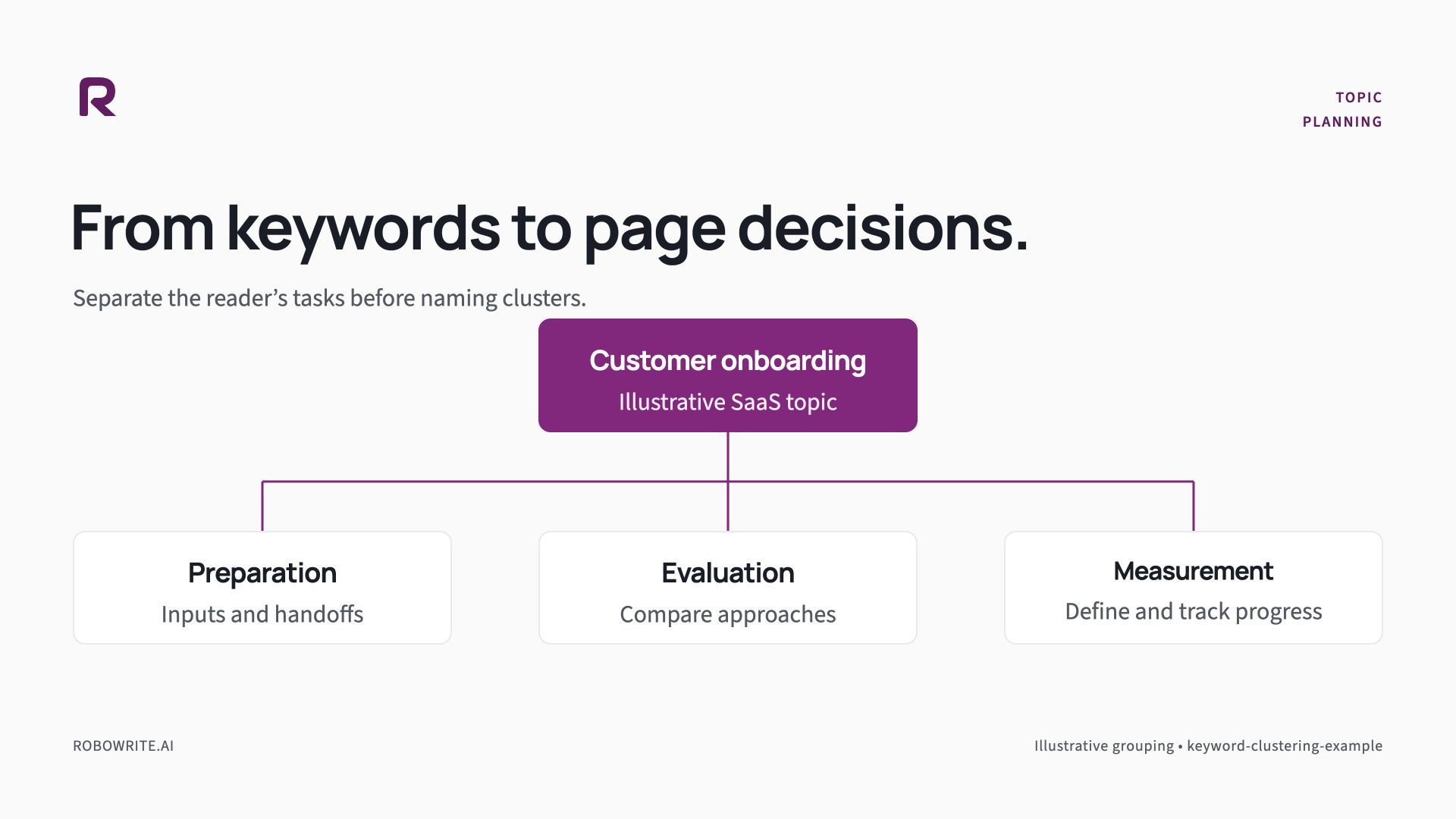
The first group asks how to prepare. The second concerns choosing a tool. The third concerns measuring an ongoing process. These tasks can connect, but one article should not attempt all of them equally.
An initial editorial grouping looks like this:
| Cluster | Primary page question | Supporting terms | Proposed format |
|---|---|---|---|
| Preparation | What should a small team confirm before onboarding begins? | requirements, handoff checklist, meeting preparation | Checklist with ownership table |
| Tool evaluation | What should a small team ask when comparing onboarding tools? | software comparison, small-team tools, implementation questions | Decision guide with sourced criteria |
| Measurement | How should the team define and review onboarding completion? | completion definition, success metrics, milestones | Measurement guide with explicit definitions |
Do not force every phrase into the first draft. The meeting-agenda query may deserve its own page if the reader expects a complete agenda rather than a short preparation section. Keep it marked for review until you inspect that distinction.
Check the Group Against Real Evidence
For each candidate cluster, review the current results for several representative phrases. Note the dominant task, format, scope, and audience. Compare that evidence with customer questions and your product knowledge.
Some tools group terms using overlapping search results; others use different methods. For example, Semrush documents a search-result comparison method. That is a description of Semrush's product, not proof that RoboWrite uses the same algorithm.
In RoboWrite, describe the grouping behavior you can actually inspect: Keyword Strategy organizes keyword inventory by pillar and topic cluster and offers article recommendations for the Topic Bank. Review the recommendations and any available metrics. An unavailable volume or difficulty value is not a measured zero.
Check Existing Pages Before Creating New Ones
Now compare each cluster with your current site. Suppose a preparation guide already exists but mixes software recommendations into its middle sections. The best action may be to improve that guide's preparation answer and move the evaluation question into a separate assignment.
Use this decision table before adding a URL:
| Existing state | Editorial action |
|---|---|
| A useful page already answers the same question | Refresh that page rather than creating a variation |
| The page touches the question but serves a different task | Add a relevant link or focused supporting section |
| Several pages substantially duplicate the answer | Review their roles and performance before choosing a consolidation |
| No page answers a relevant, supported question | Prepare a new brief with a clear reason for the page |
Two URLs appearing for a query is a reason to investigate, not automatic proof that one must be deleted. Preserve useful content and assess actual intent before planning redirects.
Turn One Cluster Into a Brief
Choose the preparation cluster first because it matches the example's reader and can be answered with a practical method. Record the main question, supporting coverage, exclusions, existing-page decision, and next step.
The article should explain the required inputs, assign owners, show a handoff table, and describe what happens when information is missing. It should exclude tool rankings and unsupported completion-rate claims. A comparison component is unnecessary for this assignment even though comparison is a separate future topic.
Then define the evidence needs. The preparation table can be an editorial recommendation. A statement that a specific tool supports a feature requires current product documentation. A customer story requires real evidence and permission.
Review the Result as a Content Plan
The cluster exercise is complete when you have useful article decisions, not when every keyword has a colored label. Each proposed page needs a distinct task, a defensible scope, and an owner for the next review.
Keep unassigned terms visible. They may be irrelevant, ambiguous, or evidence of another reader need. An honest unresolved group is more useful than a confident but incoherent page plan.
Next Step
Explore keyword clustering in RoboWrite, then use the SEO content brief template to turn one reviewed cluster into an assignment.
Sources and Further Reading
- Semrush Keyword Strategy Builder documentation: an example of vendor keyword grouping and prioritization.
- RoboWrite Public API guide: current content and strategy contracts.
- Google's people-first content guidance: evaluate the usefulness of the resulting page.