

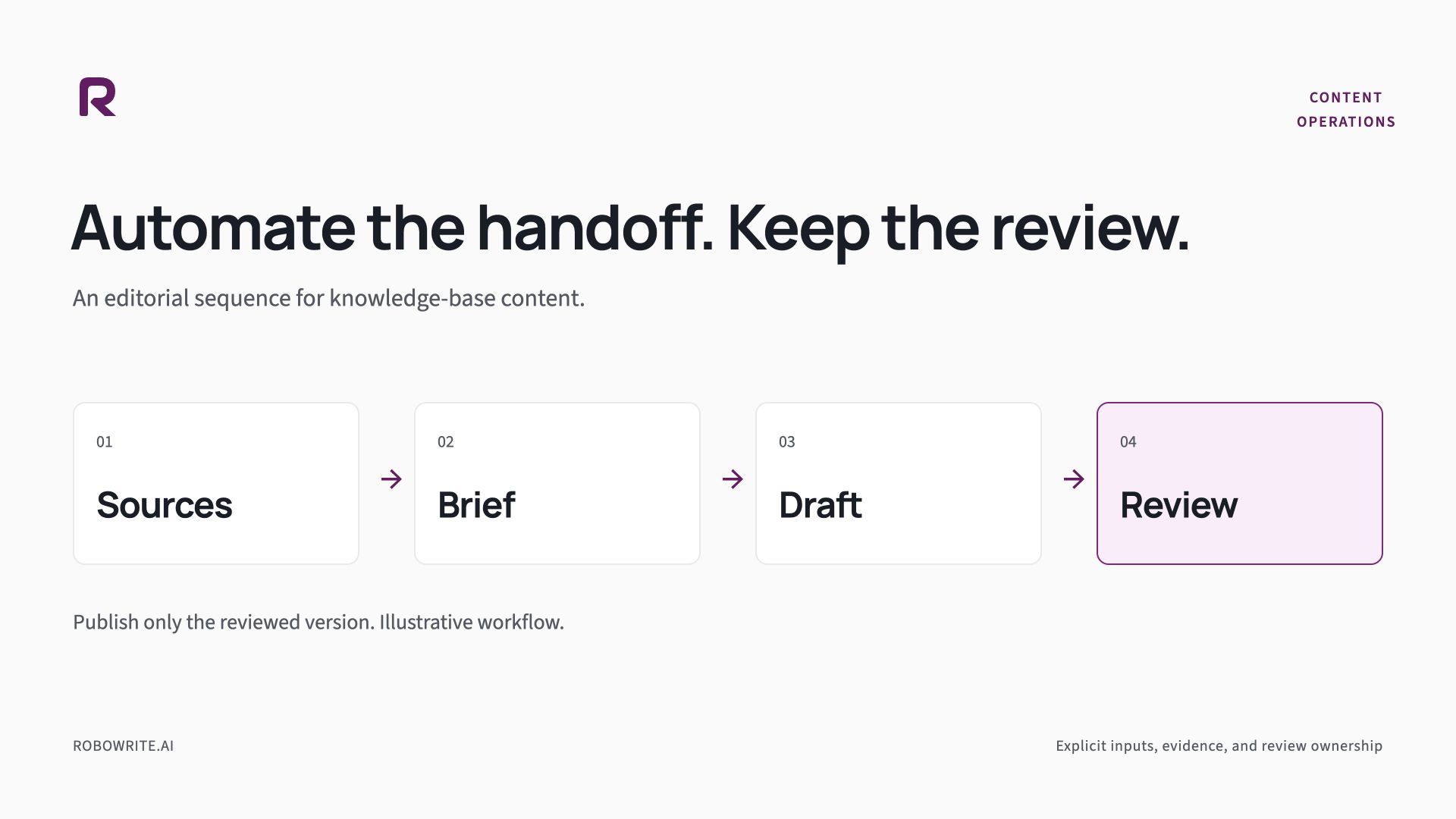
Content brief automation turns approved source material into a structured writing assignment, then routes the assignment and draft through explicit review. Automate collection, formatting, and handoffs; keep the audience, evidence, scope, and publication decision visible to an editor.
For a SaaS knowledge base, the difficult part is often deciding which product version a source describes, which reader needs the answer, and who can verify the procedure. A long automatically generated brief will not resolve those decisions by itself.
This is an editorial workflow you can adapt to your own tools. It does not describe a tested integration, promise automatic knowledge-base publishing from RoboWrite, or assume a particular help-center platform.
Define the Trigger and Source of Truth
Start with a specific trigger: a reviewed product change, a recurring support question, an outdated public procedure, or a new reader task. Record the request once with its existing URL, intended audience, and evidence owner.
Choose the authoritative source for each kind of statement. A release note can establish that a change shipped. A current product specification can establish a limitation. A support conversation can show where a reader struggled, but does not prove the product's intended behavior.
Avoid giving an automation an undifferentiated folder and asking it to treat every document as equally current. Label a source's owner, date, version, and allowed use. Keep the public brief limited to material approved for that audience.
Use a Small Input Contract
The following template makes missing information visible before a writer starts:
| Input | Required decision | Hold when |
|---|---|---|
| Reader and task | Who needs the answer and what they are trying to finish | Several incompatible audiences are combined |
| Existing destination | Update a known page or justify a new one | Another page already answers the same task |
| Source record | Identify the approved document and version | The material is missing, conflicting, or outdated |
| Product facts | Separate verified behavior from proposed behavior | A requested claim describes an unshipped capability |
| Procedure or explanation | State the expected result and relevant limits | A necessary step cannot be checked |
| Reviewer | Name the person responsible for the factual check | Nobody can verify the main answer |
| Publication destination | Identify the intended public location | The publishing tool or account is uncertain |
A hold is a useful outcome. It prevents a missing source from becoming a confident instruction in the draft. A reviewer can resolve it by supplying evidence, narrowing the question, or deciding that the article should wait.
A Worked Knowledge-Base Example
Consider a fictional SaaS workspace whose export-permission policy has changed. Support wants an article explaining who can export a report. The example is illustrative; it does not describe RoboWrite's export permissions.
The request contains a current permission matrix, an older help article, and a note that customers cannot find the relevant control. The brief should ask the writer to explain the eligible roles, the route to the control, the expected result, and the next step when access is unavailable.
It should also exclude claims that every plan includes exporting unless the current evidence establishes that. A screenshot from the old version should remain a review item rather than being silently reused as current product evidence.
| Source observation | Brief instruction | Acceptance check |
|---|---|---|
| The current policy lists eligible roles | Explain eligibility before the procedure | Each named role matches the approved matrix |
| The existing page uses an older menu label | Replace that label with verified current wording | A reviewer follows the live path |
| A support note reports confusion about access | Include a useful unavailable-access explanation | The answer states an appropriate next action |
| A screenshot predates the change | Request current product evidence | The image matches the version being documented |
This is the useful automation boundary: assemble the source references and proposed assignment, while leaving uncertain facts explicit.
Keep Brief Approval Separate From Draft Approval
Review the brief before generating prose. Confirm the reader's task, sources, exclusions, and required examples. If you need the underlying document structure, start with the SEO content brief template.
Then review the saved draft against that assignment. A good brief does not prove that the draft followed every requirement. Check the main answer, important product terms, links, limitations, and any exact procedure against the relevant evidence.
For a Content Kit, decide which article elements help this answer. A procedure may need a clear sequence in the prose. A quotation, comparison table, or statistic is useful only when it serves the task and has suitable evidence. Read how to build a Content Kit with quotes, sources, and FAQs for those component decisions.
If the assignment changes after approval, review the affected brief and draft again. An approval attached to an earlier product version does not establish that a later version is accurate.
Make Retries and Handoffs Understandable
Your production record should show the request, source version, brief version, draft version, current owner, and the next action. Before repeating a failed job, inspect whether it created a draft or completed a publication. A timeout is an uncertain result until the destination is checked.
Treat publication as a distinct action using the reviewed version and the intended destination. Read the live page afterwards: verify its answer, links, title, author, image, and actual product instructions. A saved draft or a successful job notification is not proof of the public result.
Keep ordinary editorial changes separate from URL changes. If the current page still answers the same question, update it in place. Redirects and consolidations need their own decision about the old content and incoming links.
Make the Public Answer Useful for Search
Open with the answer the intended reader needs. For the fictional export article, that means the eligibility rule and the next action, followed by the checked procedure and limitations. Put essential information in readable text, even when a screenshot or workflow diagram helps explain it.
Google's AI features guidance describes the continuing relevance of SEO fundamentals for AI Overviews and AI Mode. It does not require a special AI-specific file or schema. Use accurate content and appropriate discovery and indexing checks; do not promise that following this workflow guarantees a citation or ranking.
Measure whether the page answers the supported task. Use search queries and site behavior where available, and review confusing instructions reported through support. Separate an editorial improvement from any claim about reduced support demand unless the measurement supports that conclusion.
Start With One Complete Cycle
Choose one public article that has a verified source and a named reviewer. Complete the source-to-brief-to-draft-to-review cycle, publish through the appropriate destination, and inspect the result before adding more volume.
The SEO content workflow guide connects this handoff to keyword clusters and article planning. Use RoboWrite Content Kits when you need explicit requirements for a long-form article, while confirming your knowledge-base platform and publishing needs separately.