
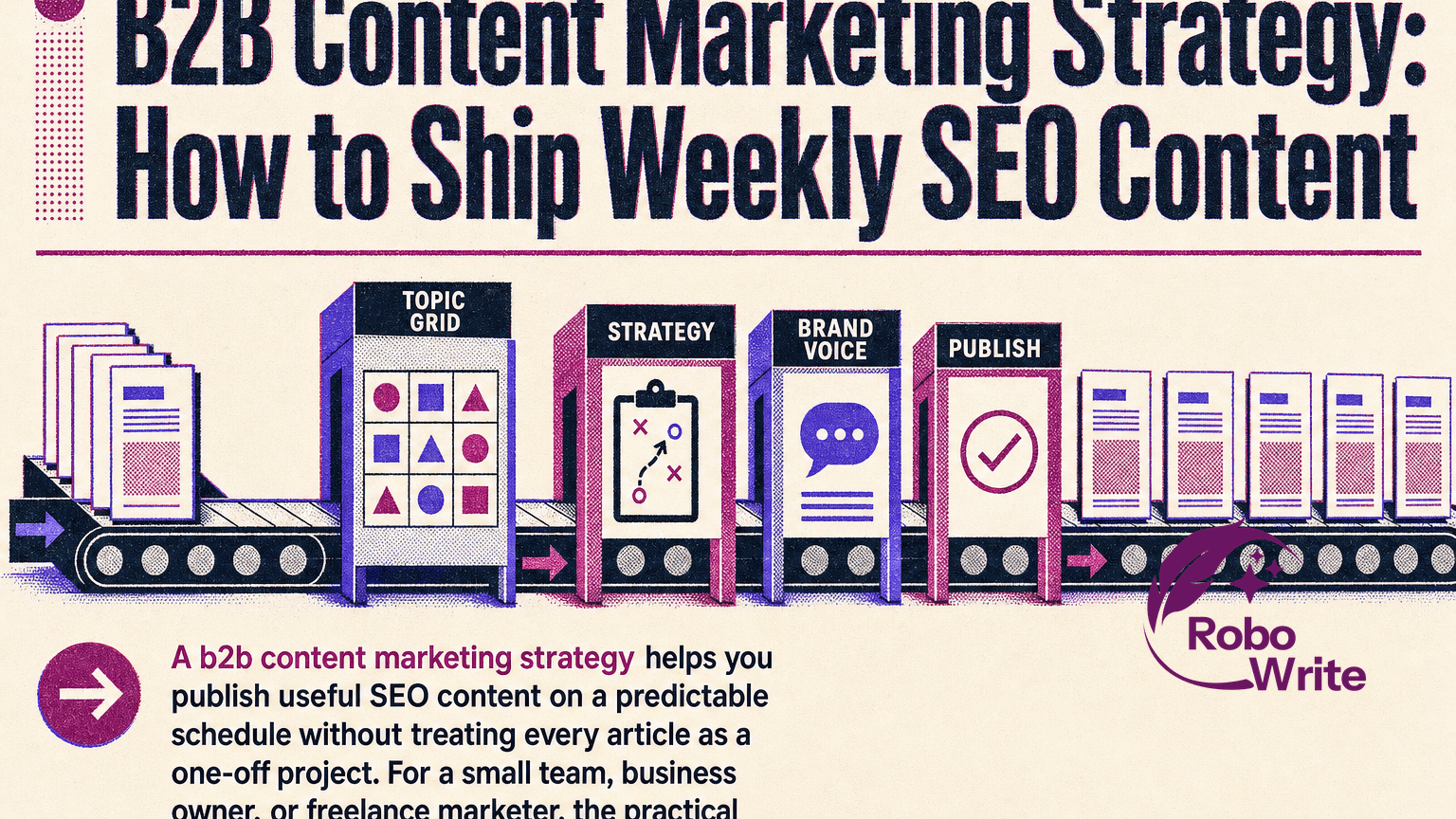
A b2b content marketing strategy helps you publish useful SEO content on a predictable schedule without treating every article as a one-off project. For a small team, business owner, or freelance marketer, the practical goal is simple: choose topics that matter to prospective buyers, produce one strong piece each week, distribute it well, and use results to improve the next cycle.
Weekly publishing is not a promise of instant rankings or leads. It is a repeatable way to build a helpful library around the problems your buyers research. The system below gives every article a purpose, owner, deadline, and measurement plan.
Why Weekly SEO Content Matters in a B2B Content Marketing Strategy
B2B, or business-to-business, describes commercial relationships between companies rather than sales to individual consumers, as this B2B definition explains. That context changes your content. You often need to help several people evaluate the same purchase: the daily user, a department leader, a technical reviewer, and a budget owner.
A good b2b content marketing strategy therefore does more than fill a blog. It answers questions that arise during a longer buying process, demonstrates that you understand a business problem, and gives prospects useful material to share internally. Buyers increasingly seek valuable information before contacting vendors, so helpful content can support familiarity and trust before a sales conversation begins, according to this overview of B2B content strategy.
Consistency matters because search content compounds as you cover connected questions over time. One post can explain a broad problem. A later post can compare approaches, clarify implementation steps, or address a common objection. Together, those pages make your expertise easier to discover and evaluate.
Do not publish weekly merely to hit a volume target. Publish weekly when each article supports a defined audience, search intent, and business objective. That discipline protects quality when your capacity is limited. Content marketing can build awareness—83% of B2B marketers achieve brand-awareness goals through it, according to Lead Forensics—but results depend on relevance and execution, not frequency alone.
Set the Strategic Foundation Before You Build the Content Calendar
Start with one or two business outcomes for the next quarter. For example, you may want to attract qualified organic traffic for a service line, help prospects understand a complex category, or give sales teams clearer educational resources. A focused objective makes topic decisions easier than a vague goal such as “publish more content.”
Next, define your highest-value buyer profiles. Write down the role, company context, recurring problem, desired outcome, and objections for each profile. Keep the list narrow at first. A team that tries to address every industry and job title usually creates broad articles that help nobody deeply.
Your strategy should also connect the audience to the customer journey. A practical framework includes audience, competitors, objectives, measurement, customer journey, and relationship-building, as LinkedIn’s B2B guidance outlines. Use that list as a planning check, not a document you complete once and forget.
Build a one-page strategy record with these fields:
- Business objective: What should content contribute to this quarter?
- Priority buyer: Which role and company type will this article help?
- Problem and outcome: What job does the buyer need to complete?
- Journey stage: Are they learning, comparing options, or validating a choice?
- Content promise: What clear answer will the article provide?
- Primary measurement: What signal will show progress?
Then add decision criteria to your editorial calendar. Score each potential article from 1 to 3 for buyer relevance, search intent, connection to your offer, evidence available, and ability to add a distinct point of view. Prioritize topics with the highest combined score. This prevents a crowded calendar of interesting ideas that do not support your wider marketing strategy.
You also need a realistic content scope. A weekly blog cadence means four or five planned articles per month, plus time for review and distribution. Choose formats your team can consistently create. Blogs, white papers, videos, podcasts, case studies, and webinars can all serve B2B audiences, as these common B2B formats show. Begin with the format that best matches your SEO goal and available expertise, then repurpose strong work into supporting assets.
Build a Weekly Topic and Keyword Research System
Create a topic backlog before the week begins. Start with the questions buyers ask in discovery calls, onboarding, support conversations, and competitor comparisons. Add recurring challenges from your sales team and terms used in your product or service research. These inputs keep keyword research tied to real business needs.
For each idea, identify the likely search intent. Informational queries call for explanations, frameworks, checklists, or definitions. Commercial-investigation queries call for comparisons, evaluation criteria, or implementation guidance. Match the article to the question behind the phrase rather than forcing a sales message into an educational search.
Use a simple keyword record for every topic:
| Field | What to capture |
|---|---|
| Primary query | The main phrase the page should address |
| Buyer question | The practical question behind the search |
| Intent | Informational, commercial, or navigational |
| Audience and stage | Role plus awareness, consideration, or decision need |
| Supporting terms | Related concepts that improve coverage |
| Evidence or expert input | Sources, examples, or internal reviewers needed |
| Priority | High, medium, or low based on strategy score |
Review search results before assigning the topic. Note the formats that currently rank, the questions they leave unanswered, and the angle your business can credibly add. Also check basic on-page requirements during planning: a specific title, readable heading structure, relevant internal links, descriptive page copy, and a meta description. On-page SEO and technical SEO both affect website visibility, so content quality should work with sound site fundamentals.
Keep three lanes in your queue. First, create foundational articles that explain important concepts in your category. Second, publish consideration content that helps buyers assess methods, requirements, or trade-offs. Third, reserve a small number of slots for timely questions from customers, market changes, or campaigns. This balance lets you plan ahead without becoming rigid.
Aim to keep at least four approved topics ready. That buffer prevents a missed publishing week when an expert is unavailable or a timely priority appears. Review the backlog monthly, remove weak ideas, and elevate topics that align with current goals. A documented calendar with assigned owners and due dates helps keep teams aligned, as this planning advice recommends.
Create a Repeatable Weekly Content Production Workflow
A reliable workflow removes avoidable decisions. It does not make content generic. Instead, it gives your team a shared way to move from topic to published article while preserving room for subject-matter expertise.
Use this six-step sequence for every weekly article:
- Create the brief. Assign the primary keyword, buyer profile, journey stage, search intent, article promise, internal links, distribution channels, and success measure. Name one accountable owner.
- Research and outline. Gather credible sources, customer language, competitor gaps, and expert input. Build an outline that answers the searcher’s main question early, then organizes supporting detail logically.
- Draft for usefulness. Write the direct answer first. Use concrete steps, definitions, examples from your own operating context, and clear transitions. Avoid unsupported claims and vague superlatives.
- Complete subject-matter review. Ask an expert to verify accuracy, nuance, terminology, and missing buyer concerns. Set a short review window and request consolidated feedback rather than scattered edits.
- Edit and optimize. Improve clarity, scanability, headings, internal links, title, meta description, and image alt text. Confirm that the draft satisfies the brief instead of adding unrelated details.
- Publish, distribute, and log learning. Publish on schedule, share through the channels named in the brief, and record the URL, publish date, topic cluster, and early performance notes.
The common bottlenecks are predictable: unclear briefs, late expert reviews, unassigned edits, last-minute keyword choices, and distribution that begins after publication. Solve these problems with deadlines that work backward from your publishing date. If you publish on Thursday, finish the outline by Monday, send the draft for review by Tuesday, and complete edits on Wednesday.
Make review responsibility explicit. The content owner manages the schedule. The writer produces the draft. The subject-matter expert checks technical accuracy. The editor controls clarity and brand consistency. One person may hold several roles on a small team, but the handoffs still need owners.
Keep your review rules narrow. Ask reviewers to identify factual corrections, missing context, and buyer objections. Do not ask every stakeholder to rewrite the article. A useful approval standard is: “Is this accurate, useful for the defined reader, and ready to publish?” That protects the schedule from preference-based revisions.
Build distribution into production. A blog post can become an email insight, several social posts, a sales enablement link, or a short script for a video. Repurposing saves effort when it extends a useful idea rather than repeating it unchanged. Fifty-three percent of marketers plan to repurpose content to extend its lifespan, according to Blue Noda.
Finally, include measurement in the brief. Decide whether this article should earn impressions, attract qualified visits, encourage newsletter signups, support a relevant conversion, or assist a sales conversation. The measure should fit the article’s journey stage. A broad educational post may first show progress through impressions and engaged visits, while a comparison guide may warrant conversion tracking.
Use Templates and Quality Controls to Keep Weekly Output Useful
Templates reduce repeated decisions. They do not replace judgment. Use three lightweight documents: an article brief, an outline template, and an editorial review checklist. Together, they form a usable b2b content marketing strategy template and a practical B2B marketing strategy template for a lean content operation.
Your brief template should capture the buyer, problem, keyword, intent, article promise, evidence, owner, due date, distribution plan, and performance goal. Your outline template should include the direct answer, key sections, internal links, proof points, and next reader action. Your checklist should ask:
- Does the article answer the intended query quickly?
- Does it match the reader’s role and journey stage?
- Are factual statements sourced or verified?
- Do headings make the logic easy to scan?
- Does on-page SEO support the topic naturally?
- Does the article give the reader a useful next step?
Complete SEO work during drafting and editing, not after approval. Check titles, headings, internal links, image descriptions, meta description, and page readability before publishing. Site speed, structured data, and on-page elements all contribute to optimization, so coordinate with whoever manages your website when a page needs technical support.
Measure Performance and Improve the Next Publishing Cycle
Measure content against the objective you set in the brief. Do not judge every article only by immediate leads. Awareness content can earn visibility and qualified visits before it produces a conversion. Consideration content may help prospects evaluate a solution or give sales teams a resource for follow-up.
Review performance monthly by topic cluster, buyer profile, journey stage, and outcome. Track search impressions, clicks, rankings where relevant, engaged visits, internal-link movement, email engagement, conversions, and sales feedback. This view shows whether a pattern is emerging. One traffic spike may be interesting; repeated performance across a topic cluster is more useful for planning.
Use the review to make three decisions. Refresh pages with declining relevance or weak search alignment. Promote successful related topics in the backlog. Improve the workflow where delays or quality issues recur. Setting metrics before launch makes testing more meaningful, as this B2B strategy guidance advises.
Record the lesson next to each published URL. For example: “The implementation checklist earned strong engagement from operations leaders,” or “The broad definition post drew impressions but needed a clearer internal link.” Over time, those notes turn your calendar into an evidence-based system rather than a list of completed tasks.
Conclusion: Scaling Your Content Output
You can sustain weekly SEO publishing when your b2b content marketing strategy connects every article to a real buyer question, a clear business purpose, and a repeatable production process. Start with a narrow audience and focused goals. Build a prioritized topic backlog, use consistent briefs and reviews, distribute each article intentionally, and review results every month.
Do not scale by adding more random topics. Scale by making the work easier to repeat and easier to improve. When your team has a dependable workflow, each weekly article can strengthen the next one—and your content library becomes more useful to the buyers you want to reach.
Sources
- B2B – Definition, FAQs & How HubSpot Helps — https
://hubspot.com/glossary/b2b - What is a B2B Content Marketing Strategy — https
://nytlicensing.com/latest/marketing/b2b-content-marketing-strategy - B2B Content Marketing Best Practices — https
://salesforce.com/marketing/b2b-automation/b2b-marketing-guide/b2b-content-marketing - The Ultimate Guide To Improve Your B2B Content Marketing Strategy — https
://linkedin.com/business/marketing/blog/content-marketing/the-ultimate-guide-to-improve-your-b2b-content-marketing-strategy - How to nail B2B marketing in 2026 [+ Pro tips, tactics, & ... — https
://blog.hubspot.com/marketing/b2b-marketing