
ThirdProof
Cybersecurity and vendor risk assessment software
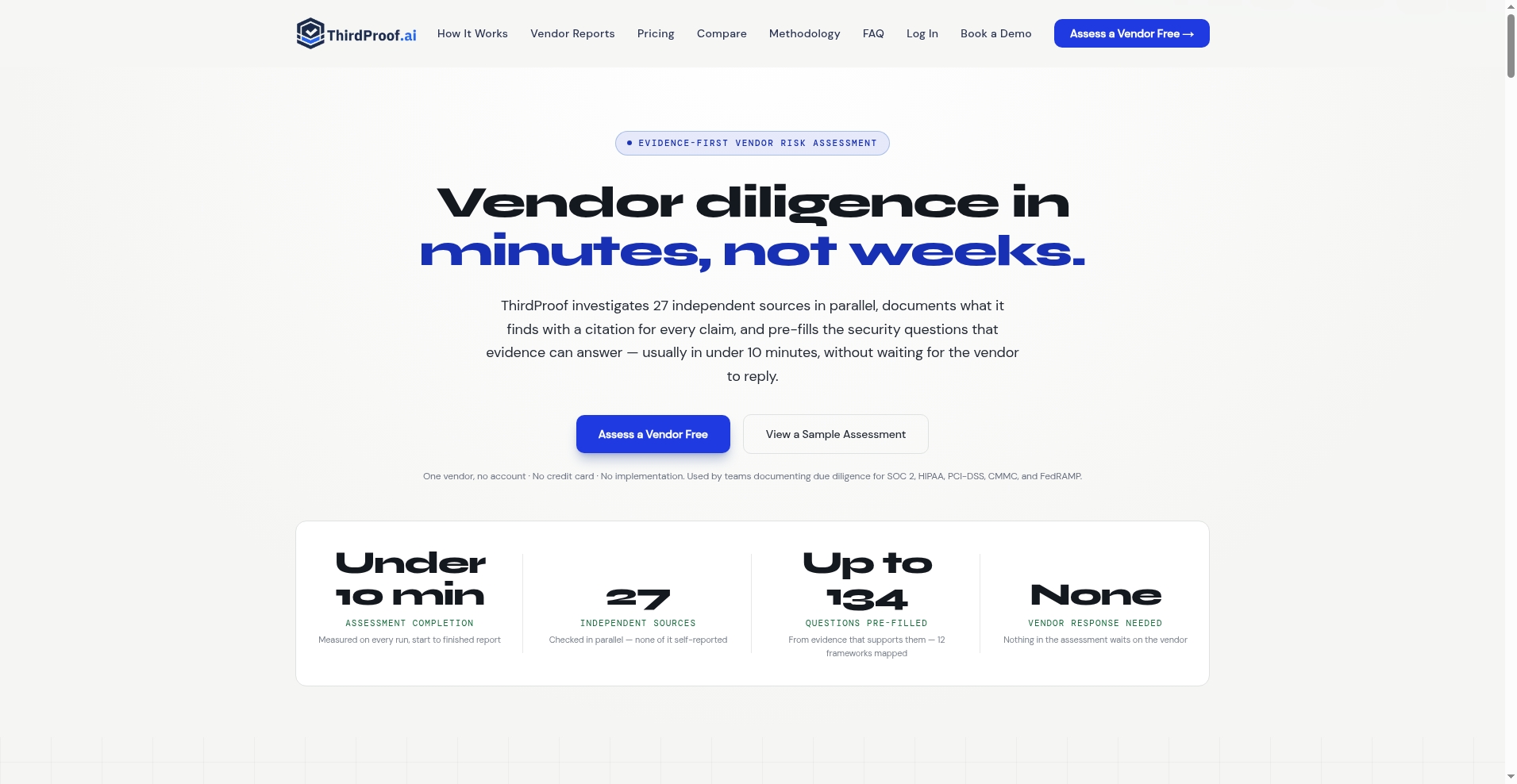
Vendor diligence in minutes, not weeks.
Audit score
67
Content
35%
90
SEO
35%
55
AI answers
30%
56
First 5 seconds
The page needs clearer next steps.
Start with search clarity, then make the homepage path easier to follow.
Audit summary
Build from the strongest visible signals first.
The public score still comes from the lead-audit rubric. Content opportunities are scored separately so the next workspace run can create work without changing the website audit result.
Content
35%
90
SEO
35%
55
AI answers
30%
56
Roadmap
Homepage changes worth making first
This translates the audit into concrete homepage modules, from the first-screen promise to FAQ, trust, and onboarding paths.
Explain evidence sources and assessment methodology
The product's core promise depends on independent evidence and source citations, but the supplied homepage does not provide a complete source inventory or detailed methodology.
See what an assessment checks, how findings are sourced, and which questions still require confirmation from the vendor.
Answer-engine content
Clarify auditor and compliance boundaries
The CC9.2 section's direct claim about satisfying a control should be reconciled with the FAQ's statement that auditor acceptance is the auditor's determination.
ThirdProof provides source-cited documentation intended to support vendor due diligence. Your auditor determines whether it meets your specific audit requirements.
Content draft
Add an annotated sample assessment
A sample can demonstrate how citations, risk tiers, and unresolved questions work, substantiating the page's central product claims.
Explore a sample assessment to see cited findings, evidence gaps, and a documented risk tier.
Content draft
Verify and complete sharing metadata
The supplied content includes a title and description but does not establish whether Open Graph or structured metadata is implemented.
Metadata refresh
RoboWrite can do this
Homepage roadmap brief
Turn the audit recommendations into sequenced homepage copy blocks.
Signal: Add visible methodology notes or links supporting the 27-source, under-10-minute, 134-question, and deterministic-tier claims.
Content draft
Draft the roadmap
Priority
Top fixes
Start with the highest-impact copy, structure, and answer-readiness gaps before moving into deeper workflow setup.
- 1
Add visible methodology notes or links supporting the 27-source, under-10-minute, 134-question, and deterministic-tier claims.
- 2
Align the CC9.2 claim with the FAQ by describing the report as documentation intended to support control evidence, not as guaranteed auditor acceptance.
- 3
Add a short, annotated sample assessment showing cited findings, unresolved items, and how the risk tier is determined.
- 4
Add a linked methodology and complete source list that supports the page's numeric claims and explains how risk tiers are assigned.
- 5
Rewrite the SOC 2 CC9.2 wording so it consistently says the documentation is designed to support evidence collection, while acceptance remains the auditor's decision.
- 6
Add a concise, annotated sample assessment that demonstrates how a cited claim, unresolved question, and risk tier appear in practice.
- 7
Verify and implement complete Open Graph and social-sharing metadata.
- 8
Check canonical, robots, and structured-data implementation; the provided content does not show these.
RoboWrite can do this
Consistent, qualified CC9.2 and framework-support copy for the homepage.
Revise control-related copy to describe the report's intended evidentiary role without implying guaranteed acceptance.
Signal: The CC9.2 section says documentation satisfies the control directly, while the FAQ says auditor acceptance is the auditor's determination.
Content draft
Clarify compliance claims
What RoboWrite could generate next
These opportunities use the content opportunity engine and do not change the public audit score.
model-1.0
What evidence can an independent vendor risk assessment verify?
Explain evidence categories, what each can establish, and what still requires vendor confirmation, using examples aligned with ThirdProof's disclosed workflow.
40
Signal
The page describes independent evidence categories and unresolved questions but does not provide a complete source inventory or methodology.
Fit
informational / tofu / explainer
Needs review (40/100) | limited data | weak: business relevance, topical authority alignment | strength: content freshness burden
Critical flags
business_relevance, topical_authority_alignment
Gates
Pass brand_safety: No brand safety concerns detected
Pass eeat_readiness: Brand has differentiators, product features, or proof assets
Unverified minimum_demand: Search volume unavailable from providers
Pass cannibalization: No existing portfolio to check against
Score detail
AI answer resilience
64
Traffic potential
38
Business relevance
24
Funnel fit
40
model-1.0
How to start vendor risk management with your first vendors
Turn the existing beginner guidance into a practical prioritization and documentation checklist without suggesting that a full program is required before starting.
42
Signal
The page identifies teams with no program and recommends beginning with vendors that handle customer data, move money, or sit in production systems.
Fit
informational / tofu / guide
Needs review (42/100) | limited data | weak: business relevance, topical authority alignment | strength: content freshness burden
Critical flags
business_relevance, topical_authority_alignment
Gates
Pass brand_safety: No brand safety concerns detected
Pass eeat_readiness: Brand has differentiators, product features, or proof assets
Unverified minimum_demand: Search volume unavailable from providers
Pass cannibalization: No existing portfolio to check against
Score detail
AI answer resilience
72
Traffic potential
38
Business relevance
28
Funnel fit
40
model-1.0
SOC 2 CC9.2 vendor due diligence: what to document
Explain the page's stated assessment evidence and documentation role, clearly separating supporting documentation from an auditor's final determination.
45
Signal
The homepage foregrounds SOC 2 CC9.2 documentation but uses stronger control-satisfaction language than its FAQ's auditor-acceptance qualification.
Fit
informational / mofu / guide
Lower priority (45/100) | limited data | blocked by: product_icp_relevance | weak: business relevance, topical authority alignment | strength: content freshness burden
Critical flags
business_relevance, topical_authority_alignment
Gates
Pass brand_safety: No brand safety concerns detected
Pass eeat_readiness: Brand has differentiators, product features, or proof assets
Unverified minimum_demand: Search volume unavailable from providers
Pass cannibalization: No existing portfolio to check against
Score detail
AI answer resilience
64
Traffic potential
38
Business relevance
22
Funnel fit
70
Search
SEO readiness
The SEO section uses the technical foundation, content quality, and authority signals rubric rather than a generic checklist.
Technical foundation
A descriptive title and meta description are provided, but the supplied content does not establish whether Open Graph data, structured metadata, or other technical elements are present. The visible duplicate skip-to-main-content text is a minor content-extraction irregularity.
What the audit found
- - Title is present: 'Vendor Risk Assessment in Minutes | ThirdProof'.
- - Meta description clearly states the vendor-investigation proposition and timing claim.
- - Site name is identified as ThirdProof in the provided metadata.
What to improve
- - Verify and implement complete Open Graph and social-sharing metadata.
- - Check canonical, robots, and structured-data implementation; the provided content does not show these.
- - Review rendered and extracted page content for repeated skip-link text.
Content quality
The page offers substantial, well-organized content covering the product workflow, audience, outputs, limitations, compliance contexts, pricing, and beginner questions. Some claims and control language would benefit from stronger supporting evidence and tighter qualification.
What the audit found
- - Detailed three-step workflow explains input, investigation, and decision.
- - Sections address use cases, frameworks, product boundaries, pricing, and common objections.
- - FAQ answers multiple practical questions for people new to vendor risk.
What to improve
- - Add methodology and evidence supporting key performance and coverage claims.
- - Clarify the scope of control-related claims and align them with the auditor-acceptance FAQ.
- - Reduce repeated speed and no-setup messaging to make room for evidence and methodology.
Authority signals
The page includes source-cited assessment claims, a named testimonial, and a completed-assessment count, but their supporting context is limited in the supplied content. It does not visibly provide detailed methodology or independently verifiable evidence for its prominent claims.
What the audit found
- - The page says every assessment claim links to a source and describes independent source categories.
- - A testimonial is attributed to April S., Compliance Lead.
- - The page states 500+ assessments completed and shows a sample SOC 2 evidence statement.
What to improve
- - Provide context or verification for the assessment-volume figure and testimonial.
- - Publish assessment methodology, source coverage, and risk-tier rules.
- - Make a complete sample report available to demonstrate evidence quality and limitations.
RoboWrite can do this
SEO refresh plan
Build metadata, headings, and page copy around the strongest SEO opportunities.
Signal: A descriptive title and meta description are provided, but the supplied content does not establish whether Open Graph data, structured metadata, or other technical elements are present. The visible duplicate skip-to-main-content text is a minor content-extraction irregularity.
Metadata refresh
Plan the SEO refresh
Answer engines
AI answer readiness
The AI readiness section uses the GEO rubric: structure, direct answer quality, and citation strength.
Content structure
The page has clear sections, numbered steps, lists, and FAQ formatting that support extraction. Some sections are lengthy, and the supplied content does not confirm machine-readable structured data.
What the audit found
- - Descriptive sections cover the problem, product outputs, workflow, audiences, boundaries, and FAQs.
- - The 'How It Works' process is presented in three numbered stages.
- - FAQ entries are organized as explicit questions and answers.
What to improve
- - Make long FAQ responses more concise and lead each with a direct answer.
- - Ensure headings and FAQ content use semantic markup and appropriate structured data.
- - Publish a compact source and methodology section that can be quoted independently.
Answer readiness
The page answers many likely questions directly, especially in the FAQ and product-boundary sections. Some answers are lengthy and important claims can be separated more clearly from promotional framing.
What the audit found
- - Directly states what ThirdProof does and what it does not do.
- - Explains when vendor contact is still necessary and what the assessment provides.
- - Gives beginner guidance on selecting initial vendors to assess.
What to improve
- - Add concise, answer-first definitions for assessment scope, risk tiers, and evidence limitations.
- - Separate framework support from any implication of guaranteed compliance or auditor approval.
- - State the conditions or methodology behind numeric claims near the claims themselves.
Citation strength
Source citations are central to the product proposition, and the page names evidence categories, but the supplied page content does not enumerate the sources or provide visible substantiation for several product-level claims. A sample assessment and methodology would improve citation confidence.
What the audit found
- - The page says each assessment claim links to a source and answers are backed by source URLs.
- - It names sanctions databases, threat intelligence feeds, certification registries, SSL analysis, and adverse media.
- - It states specific coverage and timing figures without visible methodology or supporting references in the supplied content.
What to improve
- - Link to the full source inventory and explain source freshness and availability.
- - Provide an annotated sample showing citations and how claims are tied to evidence.
- - Document the basis for performance, coverage, and risk-tier claims.
RoboWrite can do this
A concise, answer-first source and methodology page draft with a glossary of evidence categories.
Draft a methodology and source-coverage explainer that clearly distinguishes evidence types, availability, and limitations.
Signal: The page claims 27 independent sources and source citations for every finding, but the supplied content does not enumerate all sources or explain the assessment methodology.
Answer-engine content
Draft methodology explainer
RoboWrite can do this
An answer-first FAQ draft covering scope, vendor contact, risk tiers, and evidence limitations.
Restructure FAQs into concise, standalone answers while preserving product limitations and qualifications.
Signal: The page has useful FAQs, but several responses are long and combine direct answers with detailed sales context.
Answer-engine content
Improve FAQ answers
FAQ
Questions the homepage should answer
These answers help brand-new visitors understand the offer quickly and give answer engines concise language to extract.
What does ThirdProof do?
ThirdProof investigates a vendor using independent evidence sources, creates a source-cited assessment, pre-fills questionnaire answers where evidence supports them, and identifies unresolved questions. Your team makes the final decision about whether to proceed.
Answer-engine content
Do I still need to contact the vendor after an assessment?
Often, yes. The assessment can help identify what independent evidence establishes and which questions still require vendor confirmation, such as contractual commitments or specific data-handling details.
Answer-engine content
Is ThirdProof a complete third-party risk management platform?
No. The page describes ThirdProof as an on-demand vendor investigation and documentation tool, not a platform for contract lifecycle tracking, multi-stage approvals, procurement orchestration, or formal issue management.
Answer-engine content
Does a ThirdProof assessment guarantee auditor acceptance?
No. The page states that auditor acceptance is the auditor's determination. ThirdProof provides source-cited assessment documentation intended to support due diligence, and identifies evidence it could not retrieve.
Answer-engine content
RoboWrite can do this
Homepage FAQ draft
Draft concise FAQ answers that make the homepage easier to quote and understand.
Signal: Quantitative claims and methodology are not visibly attributed to a study, documentation page, or detailed source list.
Answer-engine content
Draft FAQ answers
Indexing
Metadata
Metadata is shown as audit evidence, then RoboWrite can turn it into a rewritten title, description, and social sharing summary.
Page title
Vendor Risk Assessment in Minutes | ThirdProof
Meta description
Vendor diligence in minutes, not weeks. ThirdProof investigates a vendor across 27 independent sources in parallel, documents what it finds, and pre-fills the questionnaire answers the evidence supports — without waiting for the vendor.
Open Graph
Present
Technology signals
Not detected
RoboWrite can do this
Recommended title, meta description, and social-sharing copy for review.
Create a metadata refresh proposal based on the visible product proposition and audience.
Signal: A title and meta description are supplied, but the provided content does not show Open Graph or structured metadata.
Metadata refresh
Refresh page metadata
Rubric
Full rubric
The complete rubric keeps the score explainable and separates website readiness from the scored content opportunities below it.
SEO rubric
Technical foundation
A descriptive title and meta description are provided, but the supplied content does not establish whether Open Graph data, structured metadata, or other technical elements are present. The visible duplicate skip-to-main-content text is a minor content-extraction irregularity.
What the audit found
- - Title is present: 'Vendor Risk Assessment in Minutes | ThirdProof'.
- - Meta description clearly states the vendor-investigation proposition and timing claim.
- - Site name is identified as ThirdProof in the provided metadata.
What to improve
- - Verify and implement complete Open Graph and social-sharing metadata.
- - Check canonical, robots, and structured-data implementation; the provided content does not show these.
- - Review rendered and extracted page content for repeated skip-link text.
Content quality
The page offers substantial, well-organized content covering the product workflow, audience, outputs, limitations, compliance contexts, pricing, and beginner questions. Some claims and control language would benefit from stronger supporting evidence and tighter qualification.
What the audit found
- - Detailed three-step workflow explains input, investigation, and decision.
- - Sections address use cases, frameworks, product boundaries, pricing, and common objections.
- - FAQ answers multiple practical questions for people new to vendor risk.
What to improve
- - Add methodology and evidence supporting key performance and coverage claims.
- - Clarify the scope of control-related claims and align them with the auditor-acceptance FAQ.
- - Reduce repeated speed and no-setup messaging to make room for evidence and methodology.
Authority signals
The page includes source-cited assessment claims, a named testimonial, and a completed-assessment count, but their supporting context is limited in the supplied content. It does not visibly provide detailed methodology or independently verifiable evidence for its prominent claims.
What the audit found
- - The page says every assessment claim links to a source and describes independent source categories.
- - A testimonial is attributed to April S., Compliance Lead.
- - The page states 500+ assessments completed and shows a sample SOC 2 evidence statement.
What to improve
- - Provide context or verification for the assessment-volume figure and testimonial.
- - Publish assessment methodology, source coverage, and risk-tier rules.
- - Make a complete sample report available to demonstrate evidence quality and limitations.
GEO rubric
Content structure
The page has clear sections, numbered steps, lists, and FAQ formatting that support extraction. Some sections are lengthy, and the supplied content does not confirm machine-readable structured data.
What the audit found
- - Descriptive sections cover the problem, product outputs, workflow, audiences, boundaries, and FAQs.
- - The 'How It Works' process is presented in three numbered stages.
- - FAQ entries are organized as explicit questions and answers.
What to improve
- - Make long FAQ responses more concise and lead each with a direct answer.
- - Ensure headings and FAQ content use semantic markup and appropriate structured data.
- - Publish a compact source and methodology section that can be quoted independently.
Answer readiness
The page answers many likely questions directly, especially in the FAQ and product-boundary sections. Some answers are lengthy and important claims can be separated more clearly from promotional framing.
What the audit found
- - Directly states what ThirdProof does and what it does not do.
- - Explains when vendor contact is still necessary and what the assessment provides.
- - Gives beginner guidance on selecting initial vendors to assess.
What to improve
- - Add concise, answer-first definitions for assessment scope, risk tiers, and evidence limitations.
- - Separate framework support from any implication of guaranteed compliance or auditor approval.
- - State the conditions or methodology behind numeric claims near the claims themselves.
Citation strength
Source citations are central to the product proposition, and the page names evidence categories, but the supplied page content does not enumerate the sources or provide visible substantiation for several product-level claims. A sample assessment and methodology would improve citation confidence.
What the audit found
- - The page says each assessment claim links to a source and answers are backed by source URLs.
- - It names sanctions databases, threat intelligence feeds, certification registries, SSL analysis, and adverse media.
- - It states specific coverage and timing figures without visible methodology or supporting references in the supplied content.
What to improve
- - Link to the full source inventory and explain source freshness and availability.
- - Provide an annotated sample showing citations and how claims are tied to evidence.
- - Document the basis for performance, coverage, and risk-tier claims.
RoboWrite can do this
Guided onboarding run
Turn the rubric into a sequenced workspace plan with briefs and drafts.
Signal: Add visible methodology notes or links supporting the 27-source, under-10-minute, 134-question, and deterministic-tier claims.
Brand foundation
Start workspace plan