
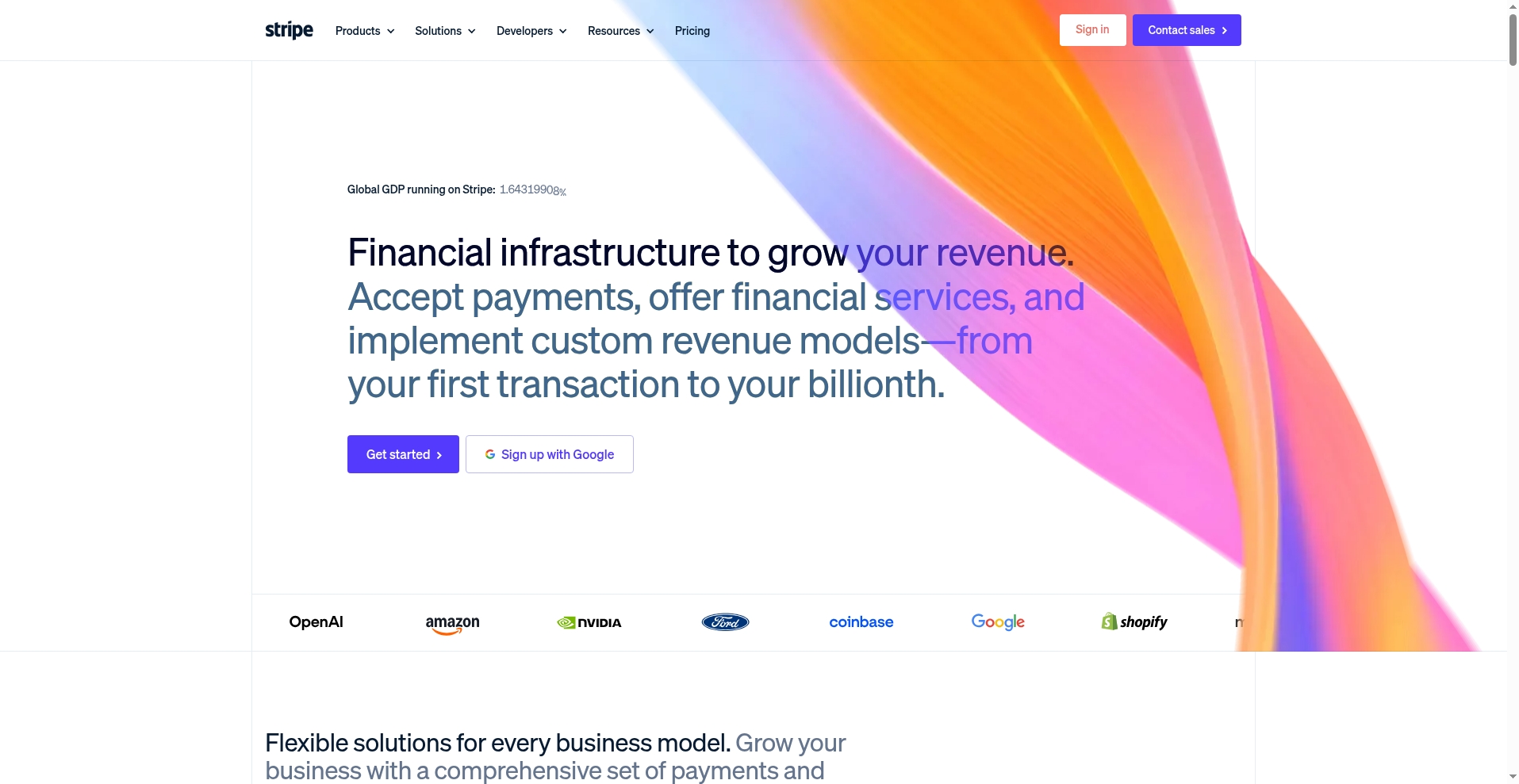
Stripe
Financial Technology (FinTech) / Payments Infrastructure
Financial Infrastructure to Grow Your Revenue
Audit score
78
Content
35%
91
SEO
35%
80
AI answers
30%
61
First 5 seconds
The page has a usable foundation.
Start with answer-engine readiness, then make the homepage path easier to follow.
Audit summary
Build from the strongest visible signals first.
The public score still comes from the lead-audit rubric. Content opportunities are scored separately so the next workspace run can create work without changing the website audit result.
Content
35%
91
SEO
35%
80
AI answers
30%
61
Roadmap
Homepage changes worth making first
This translates the audit into concrete homepage modules, from the first-screen promise to FAQ, trust, and onboarding paths.
Roadmap guidance was unavailable for this run.
The audit did not return generated homepage roadmap items.
RoboWrite can do this
Homepage roadmap brief
Turn the audit recommendations into sequenced homepage copy blocks.
Signal: Add a concise FAQ section to the homepage addressing top buyer questions (pricing, comparisons, setup time) to improve both conversion and AI discoverability
Content draft
Draft the roadmap
Priority
Top fixes
Start with the highest-impact copy, structure, and answer-readiness gaps before moving into deeper workflow setup.
- 1
Add a concise FAQ section to the homepage addressing top buyer questions (pricing, comparisons, setup time) to improve both conversion and AI discoverability
- 2
Surface 2–3 outcome-based metrics from case studies (e.g., 'Le Monde went live in under 3 months') more prominently in hero or social proof sections
- 3
Add a brief 'How Stripe Works' explainer section with a simple 3-step flow to reduce friction for first-time visitors unfamiliar with the platform
- 4
Add a structured FAQPage section with 5–8 direct Q&A pairs targeting high-intent queries (e.g., 'What is Stripe used for?', 'How much does Stripe cost?', 'How does Stripe handle fraud?')
- 5
Implement JSON-LD schema markup (Organization, FAQPage, Product) to make key facts and entities machine-readable for AI crawlers and answer engines
- 6
Expand the homepage's case study summaries to include explicit before/after outcome statements (e.g., 'Company X reduced churn by Y% after switching to Stripe Billing') to maximize citation-friendly evidence density
- 7
Add a 'How It Works' narrative section for first-time visitors
- 8
Surface pricing details more prominently on the homepage
RoboWrite can do this
Prioritized homepage update brief
Turn the highest-priority gaps into a short content and copy update plan.
Signal: Add a concise FAQ section to the homepage addressing top buyer questions (pricing, comparisons, setup time) to improve both conversion and AI discoverability
Content draft
Draft the fixes
Search
SEO readiness
The SEO section uses the technical foundation, content quality, and authority signals rubric rather than a generic checklist.
Content quality
The homepage delivers comprehensive, well-organized content covering product breadth, social proof, developer capabilities, and thought leadership — all with strong topical depth and specific supporting data.
What the audit found
- - $1.9T payments volume, 99.999% uptime, 135+ currencies — strong quantitative anchors throughout
- - Multiple named case studies with specific outcomes across diverse industries
- - Clear segmentation of use cases: startups, enterprises, developers, platforms
What to improve
- - Add a 'How It Works' narrative section for first-time visitors
- - Surface pricing details more prominently on the homepage
- - Include an FAQ section to address common buyer questions directly
Authority signals
Stripe demonstrates exceptional authority through enterprise customer logos, specific volume metrics, named executive quotes, industry reports, and a dedicated professional services ecosystem.
What the audit found
- - Recognizable enterprise customers: Hertz, URBN, Instacart, Le Monde, Substack, ElevenLabs
- - Named executive testimonials (e.g., Dax Dasilva, Founder/CEO of Lightspeed)
- - Stripe Press, annual letter, and Tidemark benchmark report signal thought leadership
What to improve
- - Add analyst recognition or industry awards to reinforce third-party authority
- - Link to press coverage or media mentions on the homepage
- - Surface security certifications (PCI DSS, SOC 2) more prominently
Technical foundation
The page has a strong, keyword-rich title tag and a clear, descriptive meta description that aligns well with core use cases. However, no explicit OG tags, schema markup, or structured data signals are visible in the provided content.
What the audit found
- - Title: 'Stripe | Financial Infrastructure to Grow Your Revenue' — well-optimized with primary keyword
- - Meta description clearly defines the platform and its core functions
- - No visible schema markup or structured data referenced in the page content
What to improve
- - Implement JSON-LD structured data (Organization, Product, FAQPage schemas)
- - Verify and strengthen Open Graph and Twitter Card metadata
- - Add breadcrumb schema for deeper product/feature pages
RoboWrite can do this
SEO refresh plan
Build metadata, headings, and page copy around the strongest SEO opportunities.
Signal: The homepage delivers comprehensive, well-organized content covering product breadth, social proof, developer capabilities, and thought leadership — all with strong topical depth and specific supporting data.
Metadata refresh
Plan the SEO refresh
Answer engines
AI answer readiness
The AI readiness section uses the GEO rubric: structure, direct answer quality, and citation strength.
Answer readiness
While the page answers 'what is Stripe' and 'what does Stripe do' implicitly, it does not directly address common conversational queries in an answer-first format. Most content is promotional rather than informational.
What the audit found
- - 'Stripe is a financial services platform that helps all types of businesses accept payments' — strong definitional statement in meta
- - No direct answers to 'How does Stripe work?', 'What does Stripe cost?', or 'How does Stripe compare to competitors?'
- - Case study outcomes partially answer 'What results can I expect?' but are not framed as direct answers
What to improve
- - Add answer-first content blocks that directly respond to top user questions
- - Create a dedicated FAQ section with concise, self-contained answers
- - Reframe some feature descriptions as direct answers (e.g., 'Stripe handles fraud by...')
Citation strength
The page is exceptionally rich in specific, citable statistics and named customer outcomes, making it highly suitable for AI engines to extract and attribute factual claims about Stripe's scale and capabilities.
What the audit found
- - $1.9T in payments volume processed in 2025 — precise, dateable, attributable
- - 'Decagon decreases support costs by 65% with Stripe-integrated agents' — outcome-specific, named entity
- - 99.999% historical uptime and 500M+ API requests per day — verifiable operational metrics
What to improve
- - Add source citations or links for third-party statistics (e.g., Tidemark report data)
- - Include publication dates on statistics to maintain temporal accuracy for AI engines
- - Add more named-outcome case study snippets directly on the homepage
Content structure
The page is well-sectioned with clear headings, grouped product features, and distinct content blocks that support extraction. However, the marketing-page format limits deep chunkability for specific informational queries.
What the audit found
- - Distinct sections for products, case studies, developer tools, and thought leadership
- - Stat callouts (135+ currencies, $1.9T volume) are scannable and extractable
- - No FAQ, table, or definition-list structures that would maximize LLM chunkability
What to improve
- - Add FAQ or definition sections with clear Q&A formatting
- - Use more explicit header hierarchies (H2/H3) to delineate topic boundaries
- - Introduce comparison tables or feature matrices for structured extraction
RoboWrite can do this
Answer-engine content brief
Write answer-first sections, FAQ blocks, and citation-friendly claims.
Signal: While the page answers 'what is Stripe' and 'what does Stripe do' implicitly, it does not directly address common conversational queries in an answer-first format. Most content is promotional rather than informational.
Answer-engine content
Create answer blocks
FAQ
Questions the homepage should answer
These answers help brand-new visitors understand the offer quickly and give answer engines concise language to extract.
FAQ guidance was unavailable for this run.
The audit did not return generated answer-ready FAQ suggestions.
RoboWrite can do this
Homepage FAQ draft
Draft concise FAQ answers that make the homepage easier to quote and understand.
Signal: No FAQ or Q&A section means the page cannot directly answer common conversational queries from AI answer engines
Answer-engine content
Draft FAQ answers
Indexing
Metadata
Metadata is shown as audit evidence, then RoboWrite can turn it into a rewritten title, description, and social sharing summary.
Page title
Stripe | Financial Infrastructure to Grow Your Revenue
Meta description
Stripe is a financial services platform that helps all types of businesses accept payments, build flexible billing models, and manage money movement.
Open Graph
Present
Technology signals
Not detected
RoboWrite can do this
Metadata rewrite
Rewrite the page title, description, and sharing summary around the clearest promise.
Signal: Stripe is a financial services platform that helps all types of businesses accept payments, build flexible billing models, and manage money movement.
Metadata refresh
Rewrite metadata
Rubric
Full rubric
The complete rubric keeps the score explainable and separates website readiness from the scored content opportunities below it.
SEO rubric
Content quality
The homepage delivers comprehensive, well-organized content covering product breadth, social proof, developer capabilities, and thought leadership — all with strong topical depth and specific supporting data.
What the audit found
- - $1.9T payments volume, 99.999% uptime, 135+ currencies — strong quantitative anchors throughout
- - Multiple named case studies with specific outcomes across diverse industries
- - Clear segmentation of use cases: startups, enterprises, developers, platforms
What to improve
- - Add a 'How It Works' narrative section for first-time visitors
- - Surface pricing details more prominently on the homepage
- - Include an FAQ section to address common buyer questions directly
Authority signals
Stripe demonstrates exceptional authority through enterprise customer logos, specific volume metrics, named executive quotes, industry reports, and a dedicated professional services ecosystem.
What the audit found
- - Recognizable enterprise customers: Hertz, URBN, Instacart, Le Monde, Substack, ElevenLabs
- - Named executive testimonials (e.g., Dax Dasilva, Founder/CEO of Lightspeed)
- - Stripe Press, annual letter, and Tidemark benchmark report signal thought leadership
What to improve
- - Add analyst recognition or industry awards to reinforce third-party authority
- - Link to press coverage or media mentions on the homepage
- - Surface security certifications (PCI DSS, SOC 2) more prominently
Technical foundation
The page has a strong, keyword-rich title tag and a clear, descriptive meta description that aligns well with core use cases. However, no explicit OG tags, schema markup, or structured data signals are visible in the provided content.
What the audit found
- - Title: 'Stripe | Financial Infrastructure to Grow Your Revenue' — well-optimized with primary keyword
- - Meta description clearly defines the platform and its core functions
- - No visible schema markup or structured data referenced in the page content
What to improve
- - Implement JSON-LD structured data (Organization, Product, FAQPage schemas)
- - Verify and strengthen Open Graph and Twitter Card metadata
- - Add breadcrumb schema for deeper product/feature pages
GEO rubric
Answer readiness
While the page answers 'what is Stripe' and 'what does Stripe do' implicitly, it does not directly address common conversational queries in an answer-first format. Most content is promotional rather than informational.
What the audit found
- - 'Stripe is a financial services platform that helps all types of businesses accept payments' — strong definitional statement in meta
- - No direct answers to 'How does Stripe work?', 'What does Stripe cost?', or 'How does Stripe compare to competitors?'
- - Case study outcomes partially answer 'What results can I expect?' but are not framed as direct answers
What to improve
- - Add answer-first content blocks that directly respond to top user questions
- - Create a dedicated FAQ section with concise, self-contained answers
- - Reframe some feature descriptions as direct answers (e.g., 'Stripe handles fraud by...')
Citation strength
The page is exceptionally rich in specific, citable statistics and named customer outcomes, making it highly suitable for AI engines to extract and attribute factual claims about Stripe's scale and capabilities.
What the audit found
- - $1.9T in payments volume processed in 2025 — precise, dateable, attributable
- - 'Decagon decreases support costs by 65% with Stripe-integrated agents' — outcome-specific, named entity
- - 99.999% historical uptime and 500M+ API requests per day — verifiable operational metrics
What to improve
- - Add source citations or links for third-party statistics (e.g., Tidemark report data)
- - Include publication dates on statistics to maintain temporal accuracy for AI engines
- - Add more named-outcome case study snippets directly on the homepage
Content structure
The page is well-sectioned with clear headings, grouped product features, and distinct content blocks that support extraction. However, the marketing-page format limits deep chunkability for specific informational queries.
What the audit found
- - Distinct sections for products, case studies, developer tools, and thought leadership
- - Stat callouts (135+ currencies, $1.9T volume) are scannable and extractable
- - No FAQ, table, or definition-list structures that would maximize LLM chunkability
What to improve
- - Add FAQ or definition sections with clear Q&A formatting
- - Use more explicit header hierarchies (H2/H3) to delineate topic boundaries
- - Introduce comparison tables or feature matrices for structured extraction
RoboWrite can do this
Guided onboarding run
Turn the rubric into a sequenced workspace plan with briefs and drafts.
Signal: Add a concise FAQ section to the homepage addressing top buyer questions (pricing, comparisons, setup time) to improve both conversion and AI discoverability
Brand foundation
Start workspace plan