
Bina
Personal finance education and investing decision tools
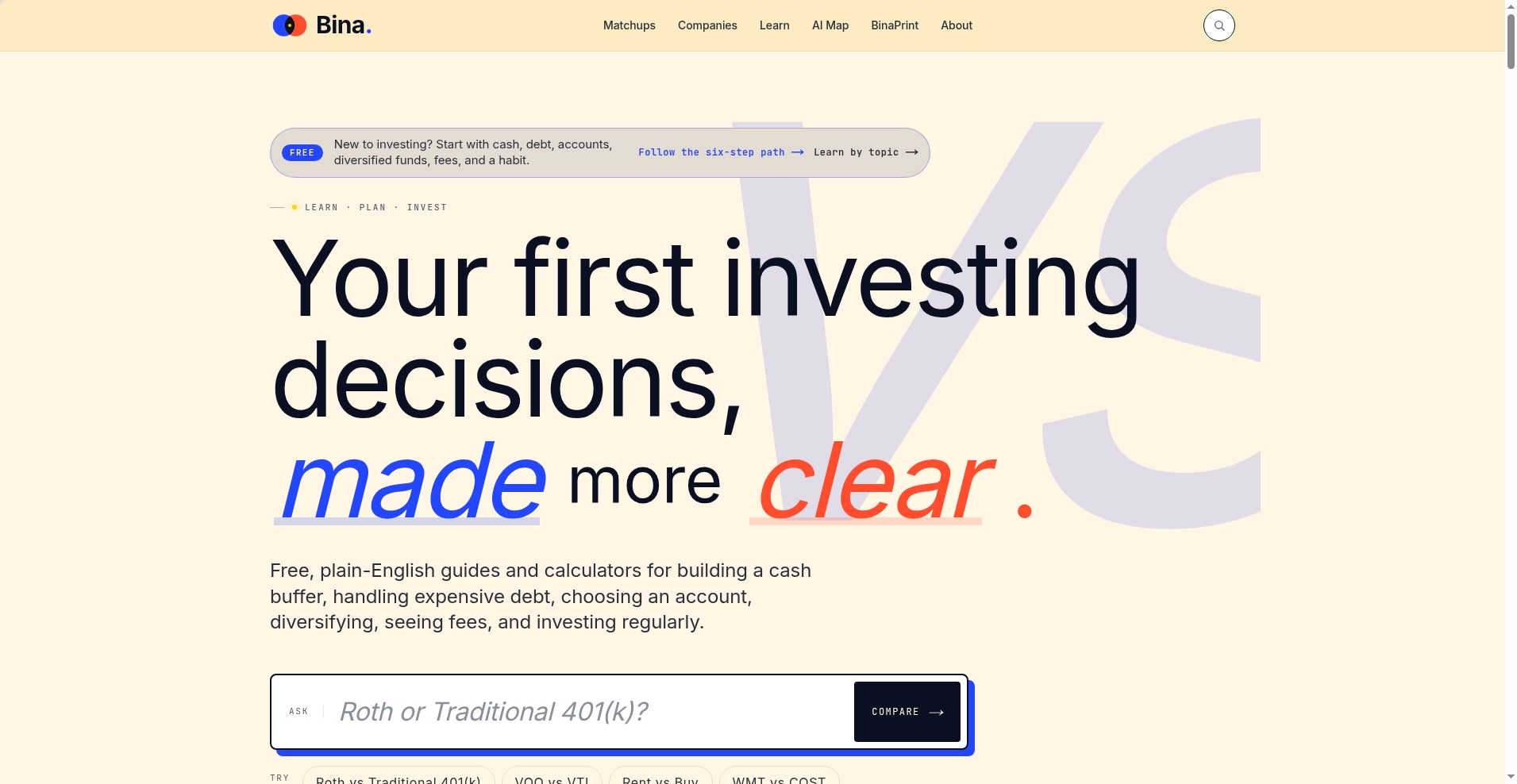
Your first investing decisions, made clearer
Audit score
65
Content
35%
91
SEO
35%
47
AI answers
30%
56
First 5 seconds
The page needs clearer next steps.
Start with search clarity, then make the homepage path easier to follow.
Audit summary
Build from the strongest visible signals first.
The public score still comes from the lead-audit rubric. Content opportunities are scored separately so the next workspace run can create work without changing the website audit result.
Content
35%
91
SEO
35%
47
AI answers
30%
56
Roadmap
Homepage changes worth making first
This translates the audit into concrete homepage modules, from the first-screen promise to FAQ, trust, and onboarding paths.
Start with the six decisions
The six-step sequence is a strong beginner resource, but the extensive catalogs compete with it for attention.
New to investing? Start with the six decisions that build a foundation: cash, debt, accounts, diversification, fees, and a contribution habit.
Content draft
Answers to common investing questions
The homepage already answers common questions, and a consistent FAQ format would make those answers easier to scan and reuse.
Should I pay off debt or invest? Compare the debt’s interest cost with uncertain investment returns, while considering an employer match, taxes, and your own time horizon.
Answer-engine content
Make tools and comparisons easier to navigate
Repeated and extensive catalogs create a dense page; clearer grouping can help readers find the relevant tool without obscuring the beginner path.
Choose a decision to explore: compare two options, learn a concept, or model your own inputs.
Content draft
Explain the research and review method
The page refers to cited sources and a common scoring method, but the supplied content does not show the supporting sources, reviewer details, or update process.
See how Bina builds comparisons: [add verified methodology, sources, reviewer information, and last-reviewed date].
Brand foundation
Align page metadata with the beginner journey
The current title and description are descriptive; consistent metadata can reinforce the same clear positioning across search and sharing previews.
Free investing guides and calculators for your first money decisions. Compare cash, debt, accounts, diversified funds, fees, and contributions in plain English.
Metadata refresh
RoboWrite can do this
Homepage roadmap brief
Turn the audit recommendations into sequenced homepage copy blocks.
Signal: Use one consistent tagline and tighten the hero to state the audience, benefit, and first action.
Content draft
Draft the roadmap
Priority
Top fixes
Start with the highest-impact copy, structure, and answer-readiness gaps before moving into deeper workflow setup.
- 1
Use one consistent tagline and tighten the hero to state the audience, benefit, and first action.
- 2
Add a prominent “Start here” six-step navigation with one guide or tool linked to each decision.
- 3
Label the methodology and evidence behind displayed comparison scores, and add visible review or update information where available.
- 4
Add a clearly labeled FAQ section with concise answers to the six core investing-decision questions and links to deeper explanations.
- 5
Show source links, assumptions, and last-reviewed dates next to factual financial and tax claims.
- 6
Break up repeated listings and standardize each answer page around a short answer, decision factors, caveats, and next step.
- 7
Verify that Open Graph and social sharing metadata are complete and consistent with the page title and description.
- 8
Implement appropriate structured data for organization, breadcrumbs, and eligible FAQ content where supported by the actual page.
RoboWrite can do this
A revised homepage outline with concise section copy and a prominent six-step start-here path.
Restructure the homepage around the beginner journey and condense secondary catalogs into clearly labeled sections.
Signal: The homepage contains a useful six-step path but also lengthy and repeated matchup and tool listings.
Content draft
Reshape homepage
What RoboWrite could generate next
These opportunities use the content opportunity engine and do not change the public audit score.
model-1.0
A beginner’s six-step investing decision guide
Turn the existing sequence into a concise, linked guide explaining what to consider at each step before choosing an investment.
41
Signal
The homepage already presents six foundational decisions but its long lists make the recommended sequence less prominent.
Fit
informational / tofu / guide
Lower priority (41/100) | limited data | blocked by: product_icp_relevance | weak: business relevance, topical authority alignment | strength: content freshness burden
Critical flags
business_relevance, topical_authority_alignment
Gates
Pass brand_safety: No brand safety concerns detected
Pass eeat_readiness: Brand has differentiators, product features, or proof assets
Unverified minimum_demand: Search volume unavailable from providers
Pass cannibalization: No existing portfolio to check against
Score detail
AI answer resilience
72
Traffic potential
38
Business relevance
23
Funnel fit
40
model-1.0
Should I pay off debt or invest?
Explain a decision framework that distinguishes high-interest debt, employer match, lower-rate debt, and uncertain investment returns, with clear caveats and citations.
39
Signal
The page identifies debt interest, uncertain market returns, employer match, taxes, and behavior as relevant tradeoffs, but visible answers could better foreground assumptions and sources.
Fit
informational / tofu / explainer
Lower priority (39/100) | limited data | blocked by: product_icp_relevance | weak: business relevance, topical authority alignment | strength: content freshness burden
Critical flags
business_relevance, topical_authority_alignment
Gates
Pass brand_safety: No brand safety concerns detected
Pass eeat_readiness: Brand has differentiators, product features, or proof assets
Unverified minimum_demand: Search volume unavailable from providers
Pass cannibalization: No existing portfolio to check against
Score detail
AI answer resilience
64
Traffic potential
38
Business relevance
21
Funnel fit
40
model-1.0
Roth or Traditional 401(k): how to compare
Provide an answer-first comparison of tax timing, employer match, withdrawals, and the personal assumptions that affect the choice.
40
Signal
The homepage names current versus future tax rates, time horizon, and future tax-law uncertainty as decision factors.
Fit
informational / tofu / comparison
Lower priority (40/100) | limited data | blocked by: product_icp_relevance | weak: business relevance, topical authority alignment | strength: content freshness burden
Critical flags
business_relevance, topical_authority_alignment
Gates
Pass brand_safety: No brand safety concerns detected
Pass eeat_readiness: Brand has differentiators, product features, or proof assets
Unverified minimum_demand: Search volume unavailable from providers
Pass cannibalization: No existing portfolio to check against
Score detail
AI answer resilience
64
Traffic potential
38
Business relevance
23
Funnel fit
40
model-1.0
ETF vs mutual fund: costs, trading, and account fit
Organize the comparison around the reader’s account and investing habits, with sourced details and clear notes that fund features vary.
48
Signal
The page already distinguishes intraday ETF trading from end-of-day mutual fund pricing and mentions fees, tax efficiency, minimums, and automatic investing.
Fit
commercial / mofu / comparison
Lower priority (48/100) | limited data | blocked by: product_icp_relevance | weak: topical authority alignment | strength: content freshness burden
Critical flags
topical_authority_alignment
Gates
Pass brand_safety: No brand safety concerns detected
Pass eeat_readiness: E-E-A-T less critical for commercial intent
Unverified minimum_demand: Search volume unavailable from providers
Pass cannibalization: No existing portfolio to check against
Score detail
AI answer resilience
56
Traffic potential
38
Business relevance
36
Funnel fit
70
model-1.0
What a stock comparison rubric can—and cannot—tell you
Explain the scoring dimensions, sources, assumptions, limitations, and update cadence using only verified methodology details.
45
Signal
Bina describes BinaPrint archetypes and a shared scoring method, while the supplied content does not show detailed evidence or assumptions behind the scores.
Fit
informational / mofu / explainer
Lower priority (45/100) | limited data | blocked by: product_icp_relevance | weak: business relevance, topical authority alignment | strength: content freshness burden
Critical flags
business_relevance, topical_authority_alignment
Gates
Pass brand_safety: No brand safety concerns detected
Pass eeat_readiness: Brand has differentiators, product features, or proof assets
Unverified minimum_demand: Search volume unavailable from providers
Pass cannibalization: No existing portfolio to check against
Score detail
AI answer resilience
64
Traffic potential
38
Business relevance
22
Funnel fit
70
Search
SEO readiness
The SEO section uses the technical foundation, content quality, and authority signals rubric rather than a generic checklist.
Technical foundation
A descriptive title and meta description are present and communicate the site’s purpose. The supplied content does not establish whether Open Graph metadata, structured data, or other machine-readable technical elements are implemented.
What the audit found
- - Title names Bina and describes its investing-decision focus.
- - Meta description identifies free guides and calculators and names the covered topics.
- - The extracted page includes headings and navigational labels, but technical markup is not visible in the provided content.
What to improve
- - Verify that Open Graph and social sharing metadata are complete and consistent with the page title and description.
- - Implement appropriate structured data for organization, breadcrumbs, and eligible FAQ content where supported by the actual page.
- - Review heading hierarchy, canonical URLs, and indexability on the live page.
Content quality
The page offers useful, relevant coverage of beginner investing decisions and provides comparisons, definitions, and calculators. Its length, repeated lists, and crowded navigation reduce focus and make the best starting point less obvious.
What the audit found
- - A six-step decision path covers cash reserves, debt, accounts, diversification, fees, and contributions.
- - Examples explain tradeoffs for common questions and name relevant decision factors.
- - The page includes tools, concepts, comparisons, and recent answers.
What to improve
- - Prioritize the beginner journey and reduce duplicated lists of matchups and tools.
- - Give each major decision a concise summary and a clear link to its full explanation or calculator.
- - Complete and review all visible answers, including content that may be truncated in extraction.
Authority signals
The page describes a consistent comparison method, refers to cited sources, and includes an educational disclaimer. The provided content does not show named authors, qualifications, source citations, or a review and update process to substantiate expertise.
What the audit found
- - Bina says comparisons use the same fixed method and make assumptions and tradeoffs visible.
- - The page describes BinaPrint as a scoring system and links to a methodology.
- - It states that the material is free educational research and not a buy or sell recommendation.
What to improve
- - Show the actual sources and assumptions supporting financial claims and comparison scores.
- - Add author or reviewer information and explain the editorial review process where applicable.
- - Display publication or last-reviewed dates on financial and tax content.
RoboWrite can do this
A methodology and editorial-transparency content brief with fields for verified sources, reviewers, and dates.
Prepare source and credibility modules using verified details supplied by Bina; flag missing facts rather than inventing them.
Signal: The page references cited sources and a methodology, but supporting sources, author credentials, and review dates are not visible in the supplied content.
Topic brief
Build trust brief
Answer engines
AI answer readiness
The AI readiness section uses the GEO rubric: structure, direct answer quality, and citation strength.
Content structure
Numbered steps, topic labels, definitions, comparisons, and question-led answers support extraction. The large volume of content and duplicated listings make the overall hierarchy less clear than it could be.
What the audit found
- - The six decisions are numbered and individually labeled.
- - Definitions and recent answers are presented as discrete entries.
- - Repeated matchup and tool lists create unnecessary duplication in the extracted content.
What to improve
- - Use a tighter heading hierarchy and reduce repeated navigation content.
- - Give each decision a self-contained summary with consistent subheadings.
- - Separate FAQs, methodology, tools, and comparison catalogs into clearly defined sections.
Answer readiness
Several sections answer recognizable questions directly and explain the factors that affect the outcome. Answers are not uniformly concise or complete, and some detailed qualifications could be more consistently surfaced.
What the audit found
- - Recent answers directly address debt versus investing, Roth versus Traditional, ETF versus mutual fund, and renting versus buying.
- - The six-step sequence gives readers an actionable order of decisions.
- - Some answers depend on individual inputs, and the page often identifies relevant factors such as rates, tax brackets, and time horizon.
What to improve
- - Lead each answer with a brief, self-contained response before providing nuance.
- - State the key assumptions and circumstances that could change each answer.
- - Ensure every answer is complete and pair it with a relevant guide or calculator.
Citation strength
The page says its comparisons include cited sources and emphasizes visible assumptions, but the supplied content does not display source attributions or evidence alongside the financial claims. This limits how confidently an answer engine can attribute or verify specific statements.
What the audit found
- - The “Why Bina” section says comparisons include cited sources.
- - The visible definitions and financial explanations do not include specific citations in the provided text.
- - Comparison scores and some tax-related claims are presented without visible supporting evidence, dates, or detailed assumptions.
What to improve
- - Display primary or otherwise credible citations adjacent to relevant claims.
- - Include dates, assumptions, and methodology for scores and calculations.
- - Distinguish general educational information from facts that depend on tax rules, jurisdiction, or individual circumstances.
RoboWrite can do this
A beginner investing FAQ draft covering the six core decisions.
Draft answer-first FAQs that state the main tradeoff, key decision factors, caveats, and relevant next step.
Signal: Recent answers address common questions, but answers are not consistently presented in a dedicated, concise FAQ format.
Answer-engine content
Draft FAQs
FAQ
Questions the homepage should answer
These answers help brand-new visitors understand the offer quickly and give answer engines concise language to extract.
What should I do before I start investing?
Bina’s suggested sequence is to build a cash buffer, address high-interest debt, choose an account, learn about diversification, understand fees, and set a contribution habit that fits your budget. The right choices depend on your circumstances.
Answer-engine content
Should I pay off debt or invest?
Compare the cost of the debt with the uncertain return from investing. Bina highlights paying attention to materially high interest rates, employer match, taxes, and the behavioral cost of carrying a balance; the appropriate choice depends on your situation.
Answer-engine content
How do I choose between a Roth and Traditional 401(k)?
A Roth contribution generally means paying tax now, while a Traditional contribution generally means paying tax when money is withdrawn. Bina says the comparison depends on your current and expected future tax brackets, time horizon, and assumptions about future tax rules.
Answer-engine content
What is the difference between an ETF and a mutual fund?
Both can hold similar investments, but ETFs trade during the day on an exchange while mutual funds typically transact once daily at net asset value. Fees, tax treatment, minimums, automatic investing features, and account fit can also differ.
Answer-engine content
Should I rent or buy a home?
The decision depends on more than the monthly payment. Bina identifies how long you expect to stay, local price-to-rent conditions, buying and maintenance costs, flexibility, and whether you would invest money not spent on buying as factors to compare.
Answer-engine content
RoboWrite can do this
Homepage FAQ draft
Draft concise FAQ answers that make the homepage easier to quote and understand.
Signal: The page is exceptionally long, and duplicated matchup and tool lists may dilute the hierarchy of the most useful answers.
Answer-engine content
Draft FAQ answers
Indexing
Metadata
Metadata is shown as audit evidence, then RoboWrite can turn it into a rewritten title, description, and social sharing summary.
Page title
Bina — Your first investing decisions, made clearer | Bina Capital
Meta description
Free, plain-English guides and calculators for the first investing decisions: cash reserves, debt, accounts, diversification, fees, and contributions.
Open Graph
Present
Technology signals
Not detected
RoboWrite can do this
A metadata refresh proposal for the homepage.
Review the existing metadata and draft consistent page title, description, and social metadata recommendations for review.
Signal: A descriptive title and meta description are present, while Open Graph and structured metadata are not verifiable from the supplied page content.
Metadata refresh
Review metadata
Rubric
Full rubric
The complete rubric keeps the score explainable and separates website readiness from the scored content opportunities below it.
SEO rubric
Technical foundation
A descriptive title and meta description are present and communicate the site’s purpose. The supplied content does not establish whether Open Graph metadata, structured data, or other machine-readable technical elements are implemented.
What the audit found
- - Title names Bina and describes its investing-decision focus.
- - Meta description identifies free guides and calculators and names the covered topics.
- - The extracted page includes headings and navigational labels, but technical markup is not visible in the provided content.
What to improve
- - Verify that Open Graph and social sharing metadata are complete and consistent with the page title and description.
- - Implement appropriate structured data for organization, breadcrumbs, and eligible FAQ content where supported by the actual page.
- - Review heading hierarchy, canonical URLs, and indexability on the live page.
Content quality
The page offers useful, relevant coverage of beginner investing decisions and provides comparisons, definitions, and calculators. Its length, repeated lists, and crowded navigation reduce focus and make the best starting point less obvious.
What the audit found
- - A six-step decision path covers cash reserves, debt, accounts, diversification, fees, and contributions.
- - Examples explain tradeoffs for common questions and name relevant decision factors.
- - The page includes tools, concepts, comparisons, and recent answers.
What to improve
- - Prioritize the beginner journey and reduce duplicated lists of matchups and tools.
- - Give each major decision a concise summary and a clear link to its full explanation or calculator.
- - Complete and review all visible answers, including content that may be truncated in extraction.
Authority signals
The page describes a consistent comparison method, refers to cited sources, and includes an educational disclaimer. The provided content does not show named authors, qualifications, source citations, or a review and update process to substantiate expertise.
What the audit found
- - Bina says comparisons use the same fixed method and make assumptions and tradeoffs visible.
- - The page describes BinaPrint as a scoring system and links to a methodology.
- - It states that the material is free educational research and not a buy or sell recommendation.
What to improve
- - Show the actual sources and assumptions supporting financial claims and comparison scores.
- - Add author or reviewer information and explain the editorial review process where applicable.
- - Display publication or last-reviewed dates on financial and tax content.
GEO rubric
Content structure
Numbered steps, topic labels, definitions, comparisons, and question-led answers support extraction. The large volume of content and duplicated listings make the overall hierarchy less clear than it could be.
What the audit found
- - The six decisions are numbered and individually labeled.
- - Definitions and recent answers are presented as discrete entries.
- - Repeated matchup and tool lists create unnecessary duplication in the extracted content.
What to improve
- - Use a tighter heading hierarchy and reduce repeated navigation content.
- - Give each decision a self-contained summary with consistent subheadings.
- - Separate FAQs, methodology, tools, and comparison catalogs into clearly defined sections.
Answer readiness
Several sections answer recognizable questions directly and explain the factors that affect the outcome. Answers are not uniformly concise or complete, and some detailed qualifications could be more consistently surfaced.
What the audit found
- - Recent answers directly address debt versus investing, Roth versus Traditional, ETF versus mutual fund, and renting versus buying.
- - The six-step sequence gives readers an actionable order of decisions.
- - Some answers depend on individual inputs, and the page often identifies relevant factors such as rates, tax brackets, and time horizon.
What to improve
- - Lead each answer with a brief, self-contained response before providing nuance.
- - State the key assumptions and circumstances that could change each answer.
- - Ensure every answer is complete and pair it with a relevant guide or calculator.
Citation strength
The page says its comparisons include cited sources and emphasizes visible assumptions, but the supplied content does not display source attributions or evidence alongside the financial claims. This limits how confidently an answer engine can attribute or verify specific statements.
What the audit found
- - The “Why Bina” section says comparisons include cited sources.
- - The visible definitions and financial explanations do not include specific citations in the provided text.
- - Comparison scores and some tax-related claims are presented without visible supporting evidence, dates, or detailed assumptions.
What to improve
- - Display primary or otherwise credible citations adjacent to relevant claims.
- - Include dates, assumptions, and methodology for scores and calculations.
- - Distinguish general educational information from facts that depend on tax rules, jurisdiction, or individual circumstances.
RoboWrite can do this
Guided onboarding run
Turn the rubric into a sequenced workspace plan with briefs and drafts.
Signal: Use one consistent tagline and tighten the hero to state the audience, benefit, and first action.
Brand foundation
Start workspace plan